
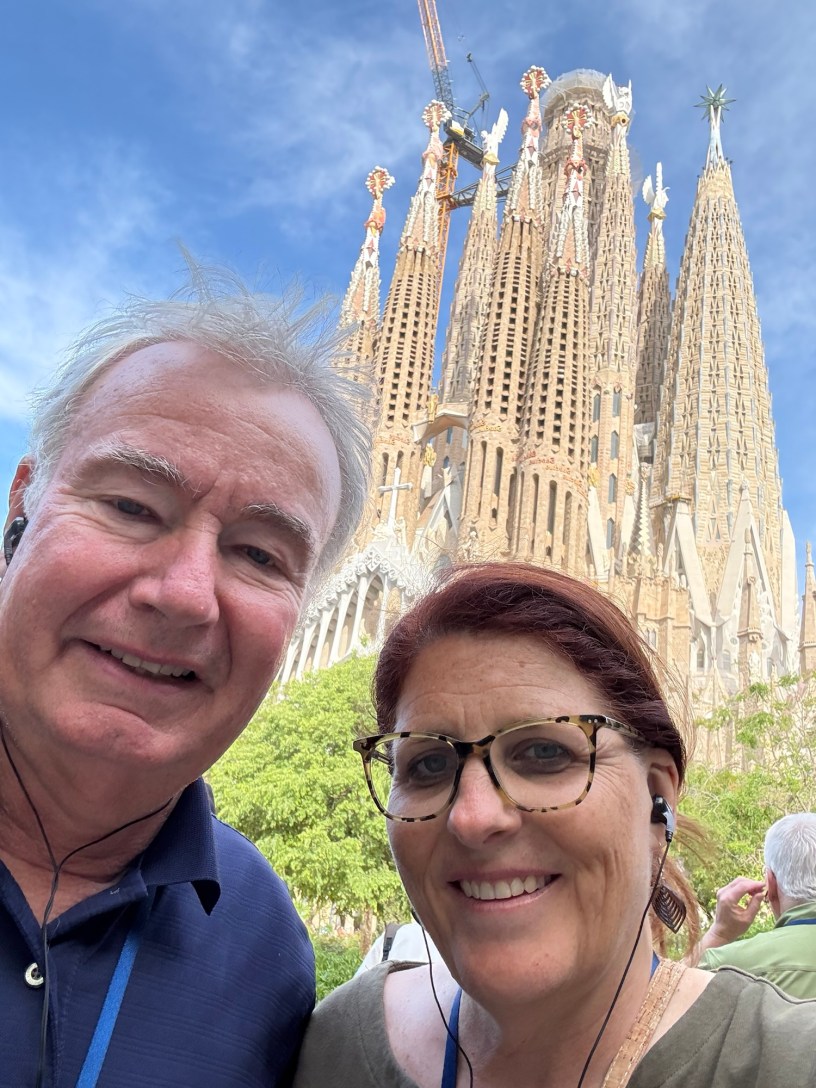

At 4 p.m., we met up with our Rick Steves tour group and were introduced to our local guide. She let us know right away that we wouldn’t be revisiting the medieval area—we’d already explored that on our own. Instead, she focused on the more modern side of Barcelona: Gaudí and the Eixample district.
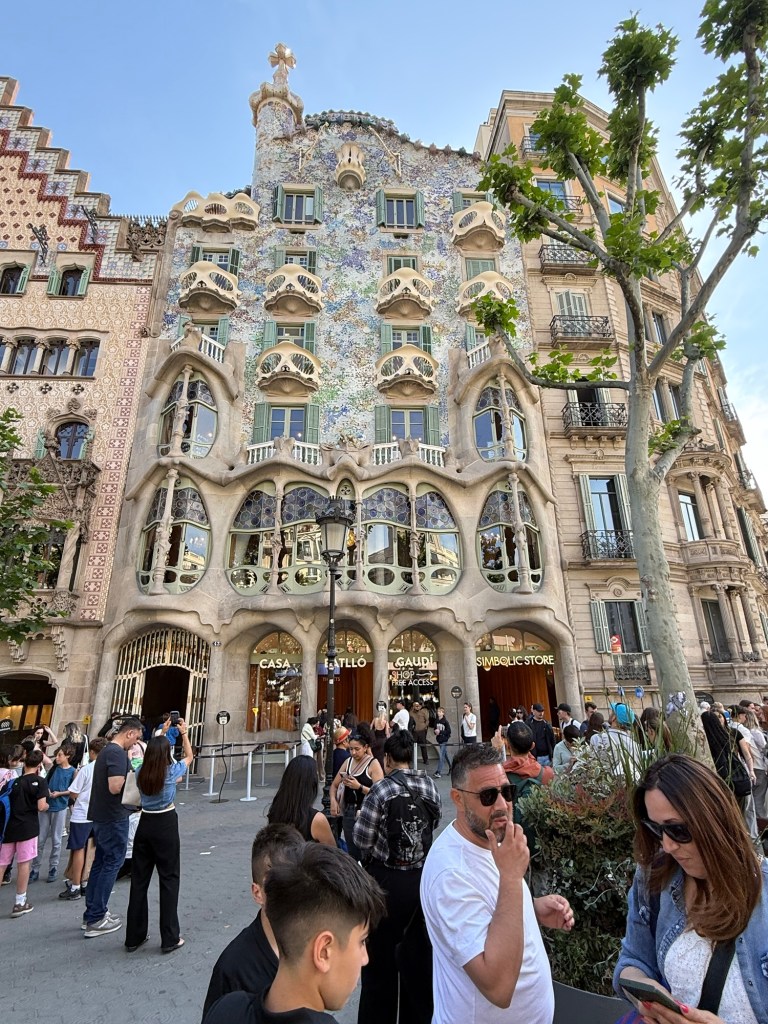
As we strolled through Eixample, she explained that this area is actually preferred by locals. While the Gothic Quarter draws the tourists, Eixample—with its wide, elegant streets and neat grid layout—feels more open and livable. She pointed out that the corners of buildings are angled to soften intersections and make room for gathering spaces. We also learned how homes were designed by class: the wealthiest families lived on the first floor (above the shops), while the help and renters lived farther up—less convenient and definitely less prestigious.
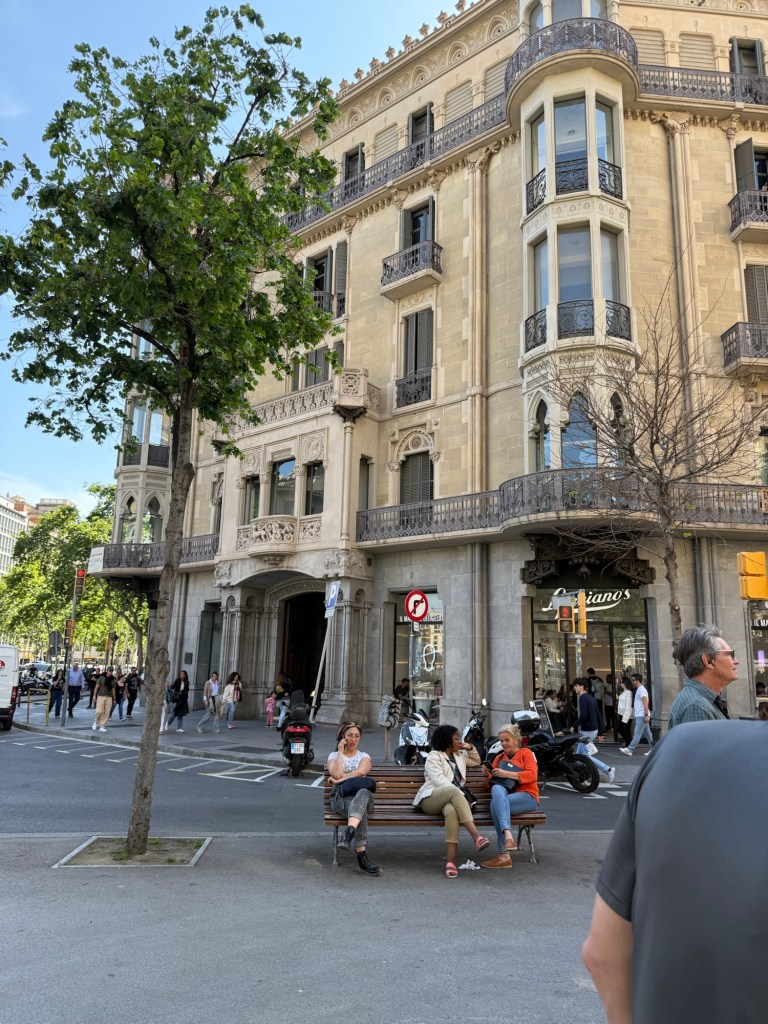
We walked past this ornate lamppost with a bat sitting on top of a crown, and our guide casually dropped that it’s actually a symbol of protection in Catalonia. Turns out, a bat supposedly brought King James I good luck before a big battle. The crown below represents royal power, and the shield ties it all back to Barcelona.
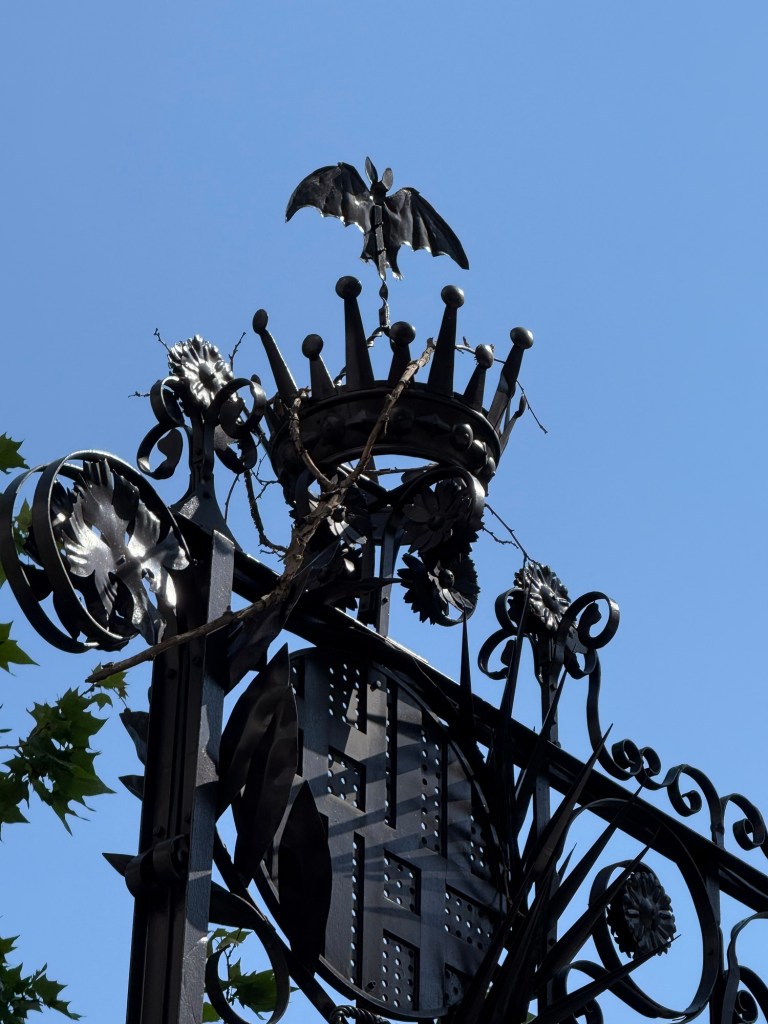
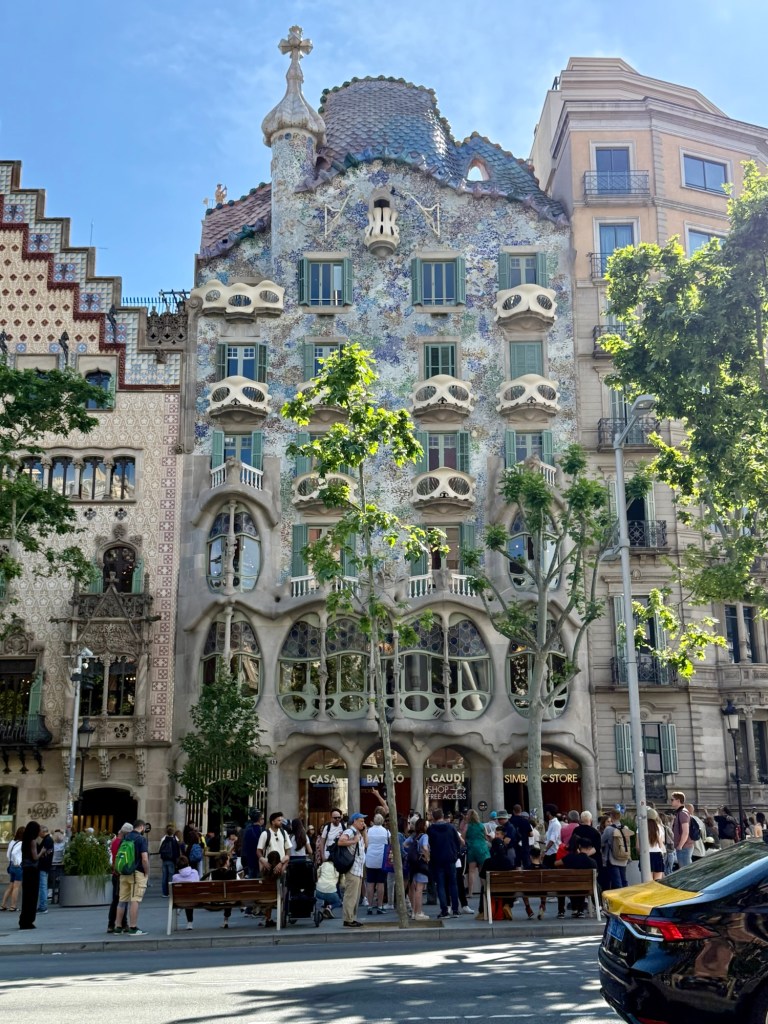
Gaudí was hired in 1904 by a wealthy textile industrialist named Josep Batlló, who owned an ordinary building in a prime spot on Passeig de Gràcia. Instead of tearing it down, he asked Gaudí to completely transform it.
The result is Casa Batlló, one of the most iconic buildings in Barcelona. We crossed the street to take it all in, and that’s when the details really hit us. The roof curves like a dragon’s back, covered in shimmering scales, and the cross-shaped tower is said to be Saint George’s sword plunged into the dragon. The balconies look like skulls or masks, giving the whole thing a surreal, almost spooky vibe.
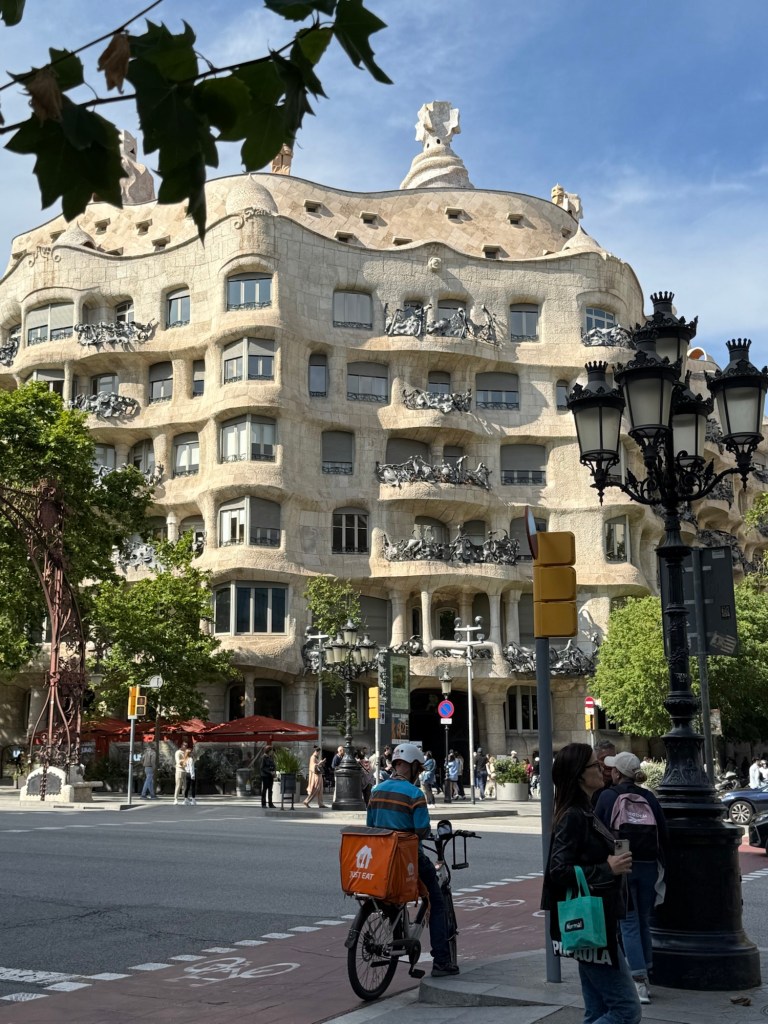
We turned about 45 degrees to the right and spotted another Gaudí masterpiece—Casa Milà, his wild, wavy creation that locals nicknamed “La Pedrera,” or “The Stone Quarry,” because of its rough, natural look. Built between 1906 and 1912 for a wealthy couple, this building was way ahead of its time. There’s not a single straight line in sight—just curving stone, twisted iron balconies that look like vines, and helmet-like chimneys on the roof that feel straight out of a dream. It caused quite a stir when it was built because it looked nothing like the elegant, symmetrical buildings people were used to. Critics called it ugly, some thought it was unfinished, and the city even fined the Milàs for breaking building codes. But Gaudí didn’t back down.
Then the tour guide shared the tragic story of Gaudí’s death—hit by a tram just blocks from the Sagrada Família and mistaken for a beggar because of his humble appearance. He was taken to a charity hospital and given poor care. By the time they realized he was a wealthy, respected architect, it was too late. Now we’re heading by metro to the Sagrada Família, the masterpiece he devoted his final years to but never saw completed.
Next, we made our way to the metro station, and somehow our guide managed to get all 26 of us through the turnstile without losing a soul. It was packed thanks to rush hour—people everywhere, shoulder to shoulder. As we grabbed onto the handlebars, smashed up against the locals, Barb blurted out, “If we don’t catch something here, it’ll be a miracle!” I could not stop laughing.
We popped out of the metro station and our guide said “turn around”.

Sagrada Família Passion Façade
The sheer size of the church hit us first—it was powerful. Towering stone columns, massive sculptures, and that made you feel tiny.

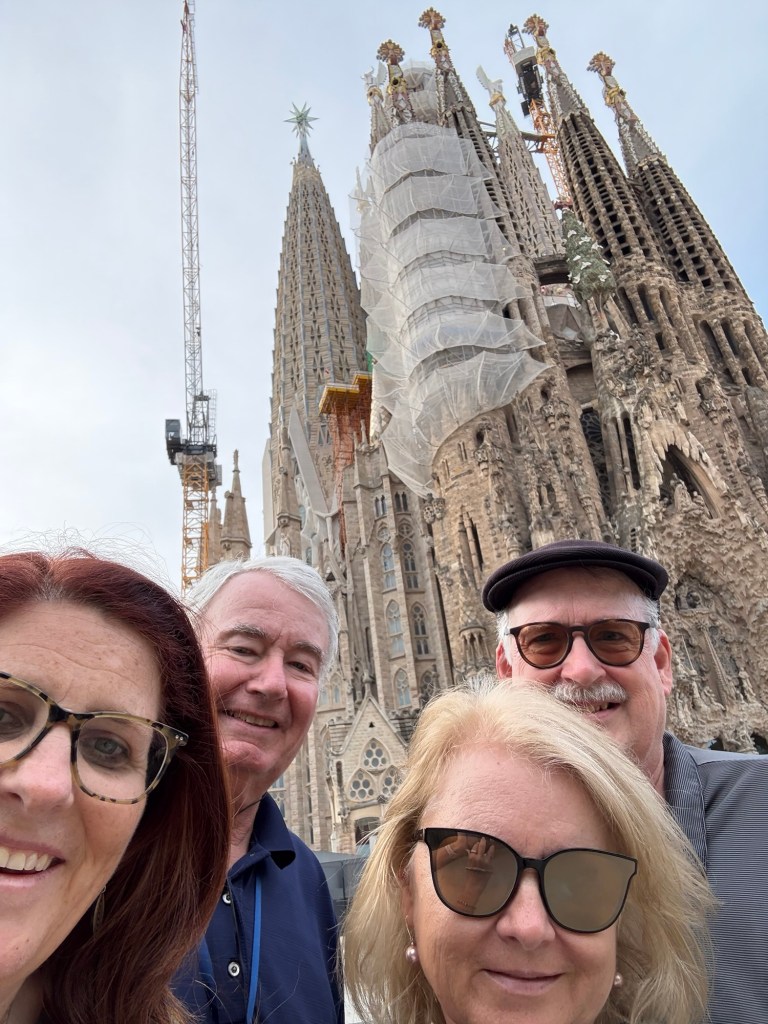
Ironically, the stone on the Nativity Façade was darker and almost spookier-looking at first glance—but the story it told was full of joy, celebrating the birth of Jesus with life, movement, and nature in every detail. Meanwhile, the Passion Façade, which we saw first when we popped out of the metro station, looked cleaner and brighter—but the message was heavy, focused on suffering and sacrifice. It was the opposite of what you’d expect, and it made the whole experience even more powerful.
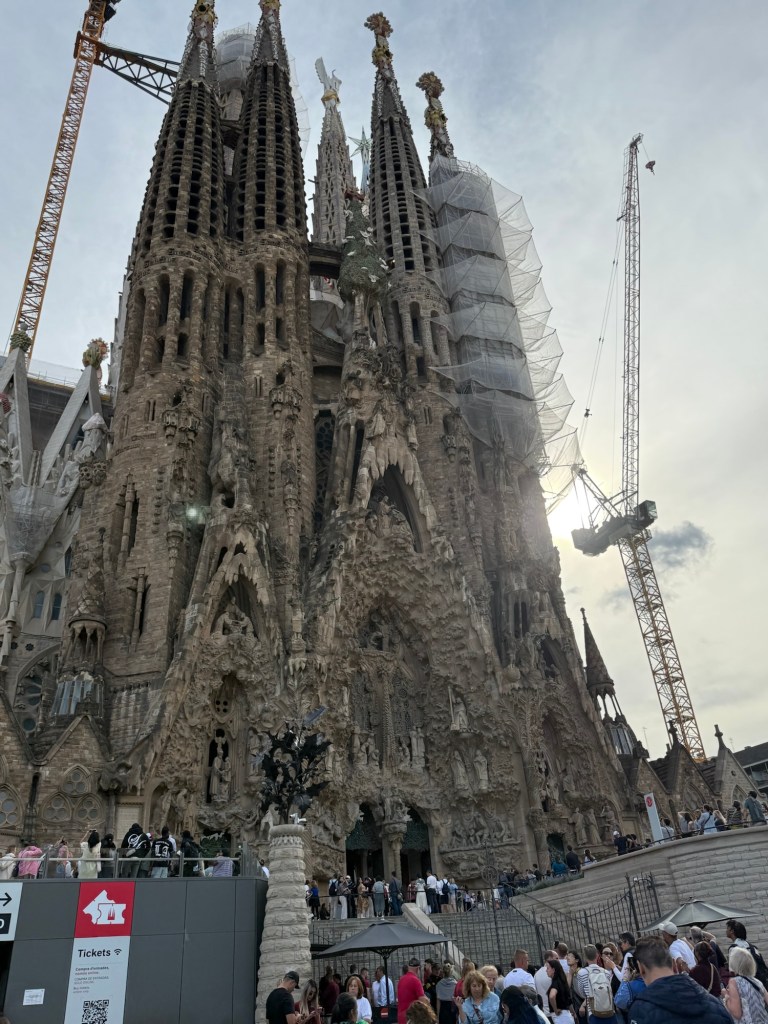
Our tour guide explained that for years, you couldn’t even go inside—the Sagrada Família was basically just a stone shell. It wasn’t until more recently that the interior was finished enough to welcome visitors. Hard to believe when you see it now.
We’ll be entering through the Nativity Façade, the older, darker, and more joyful side that Gaudí personally worked on—and exiting through the Passion Façade, with its lighter stone and somber message.
Inside, Gaudí’s genius really hits you. The stained glass is arranged by direction and time of day—cool blues and greens on the east side to catch the morning light, and warm reds and oranges on the west to glow with the afternoon sun. As the light moves through the space, it transforms everything. It’s like being inside a kaleidoscope of color and shadow.
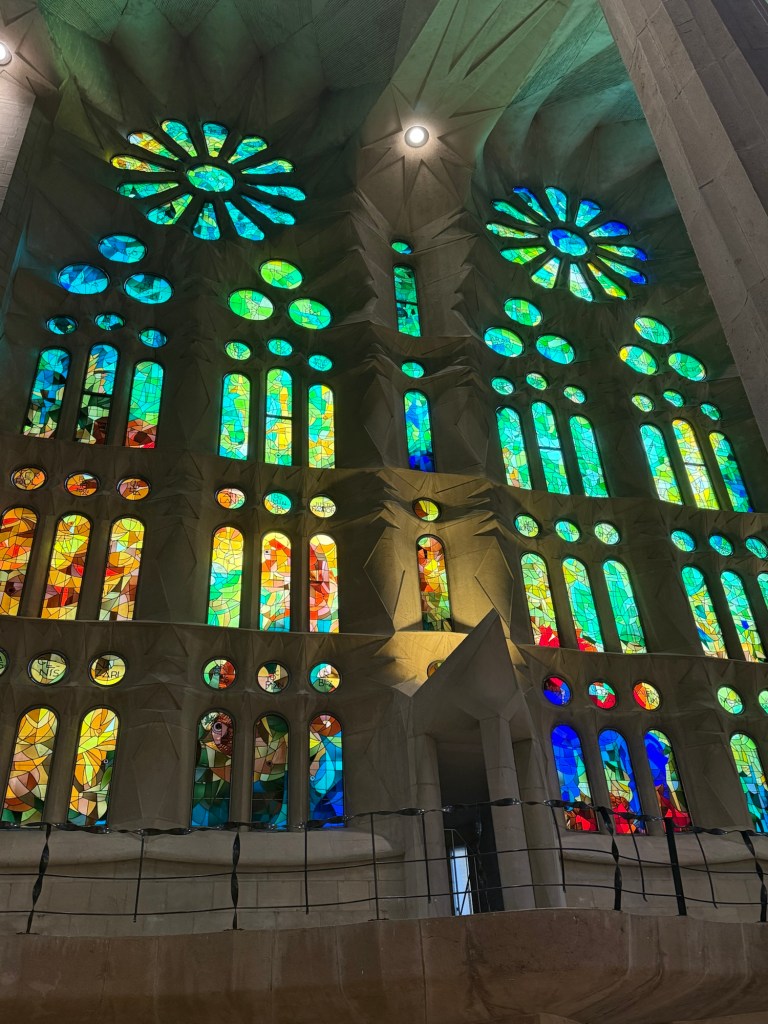
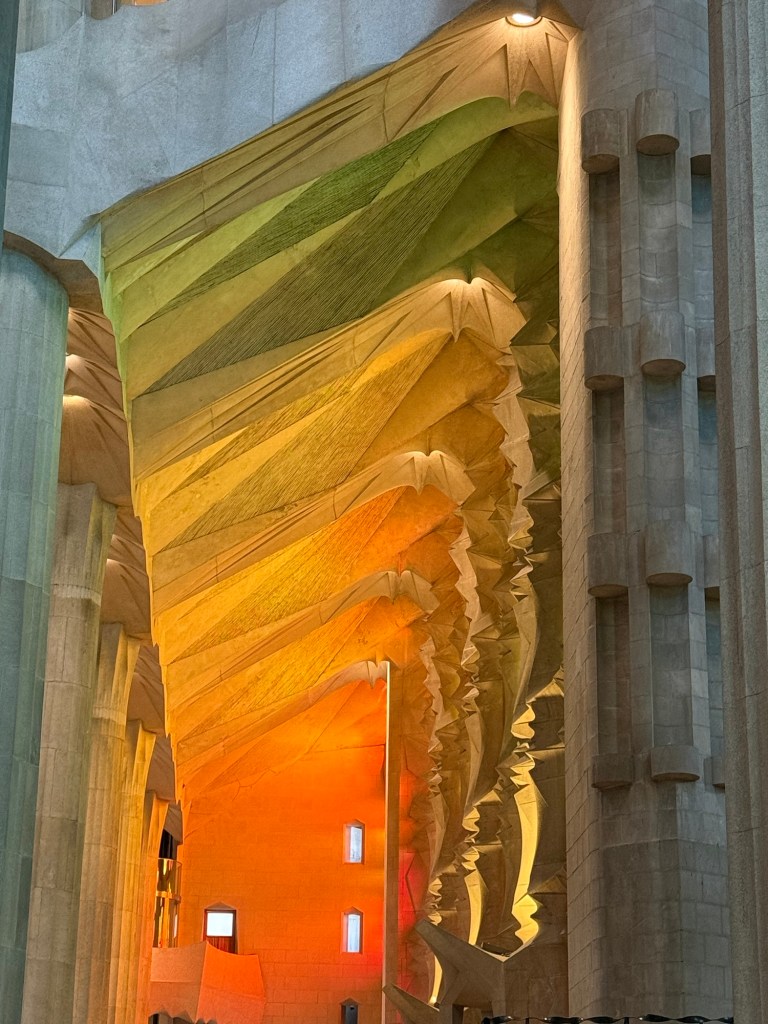

At certain times of day, the light pours through just right and casts rainbows across the columns and floors.
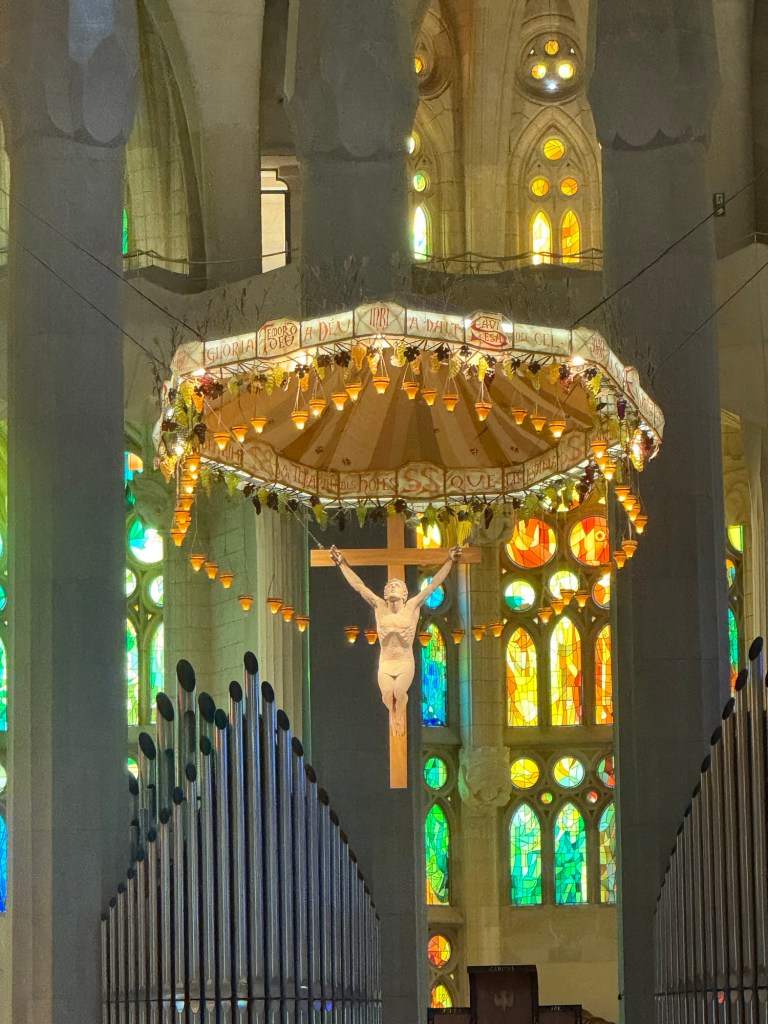
This striking altar piece was inspired by the baldachin in St. Peter’s Basilica. Suspended above Jesus on the cross is a canopy surrounded by lights shaped like grapes and wheat—symbols of communion.
The beams and columns in the Sagrada Família twist and spiral upward, creating movement and flow rather than rigid symmetry. Gaudí studied geometry in nature and used shapes like helical columns and hyperboloids to make the structure both beautiful and strong. These twisting forms distribute weight efficiently while drawing the eye upward, giving the whole space a sense of motion and life
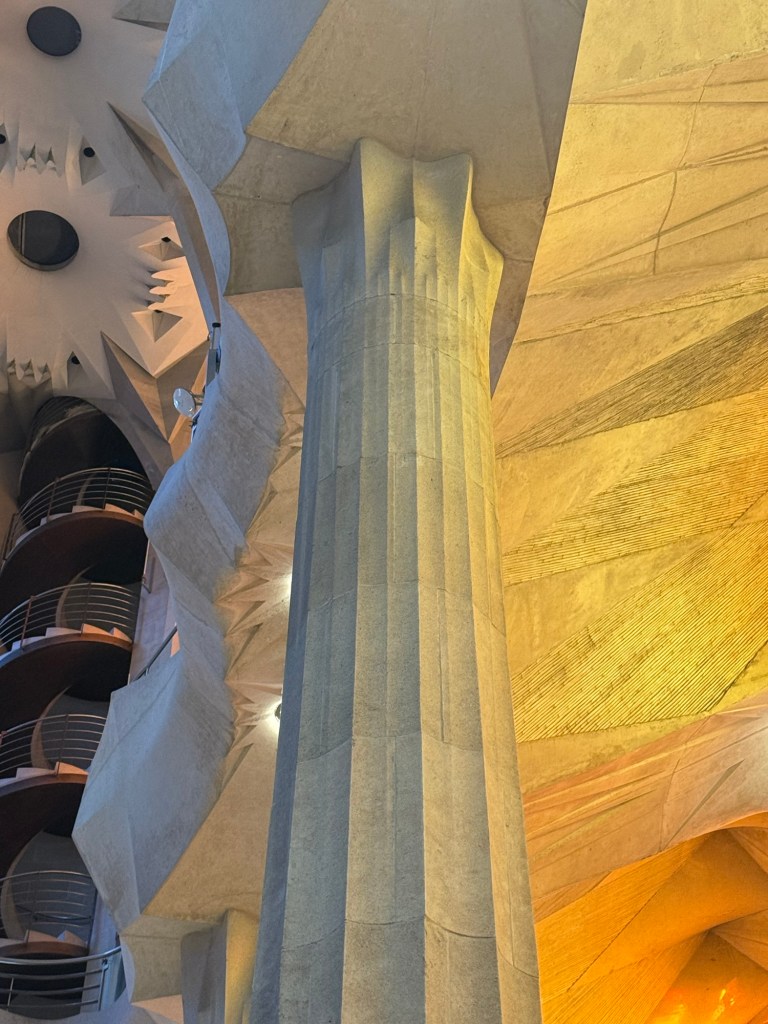
Hyperboloid Columns
Gaudí knew he wouldn’t live to see the Sagrada Família finished, so he created a detailed plaster model to guide future builders. Even today, architects and artists follow that model closely—adding their own touch, but always staying true to his vision. It’s a generational project, with each team carrying his dream forward.
This is a masterpiece that you should continue to visit as it’s constantly evolving.
Next up was dinner time around 9pm, in Spain you eat late!
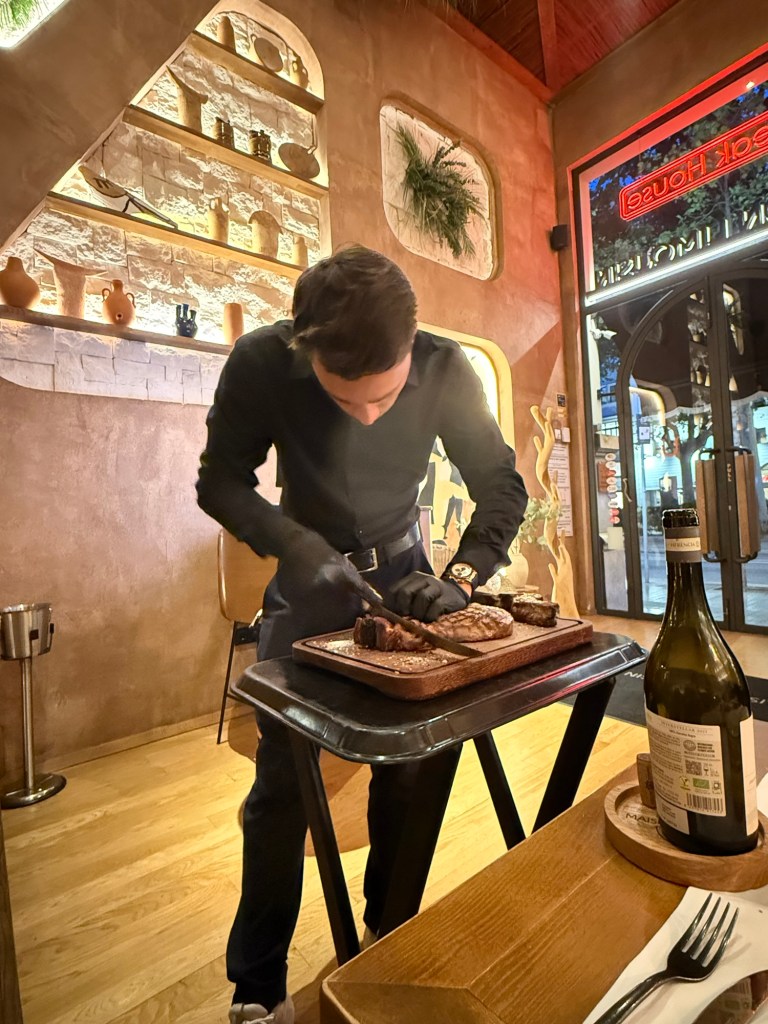
After dinner, putting in record number of steps, we hobbled home and crashed!
 Happiness is Possible