
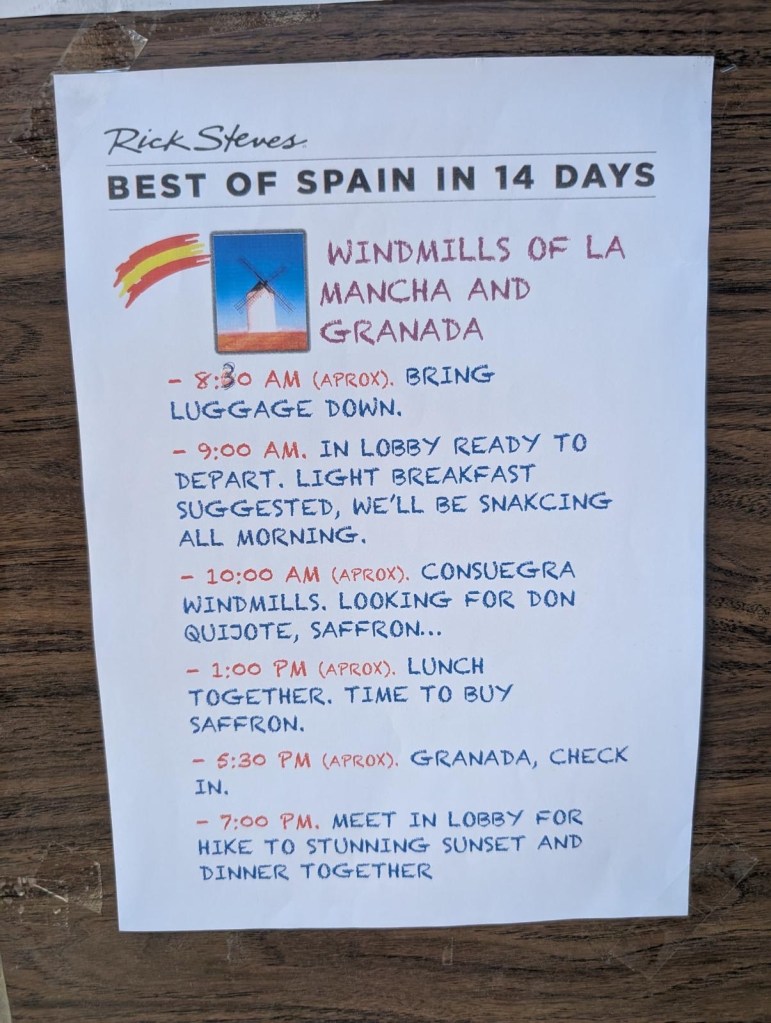
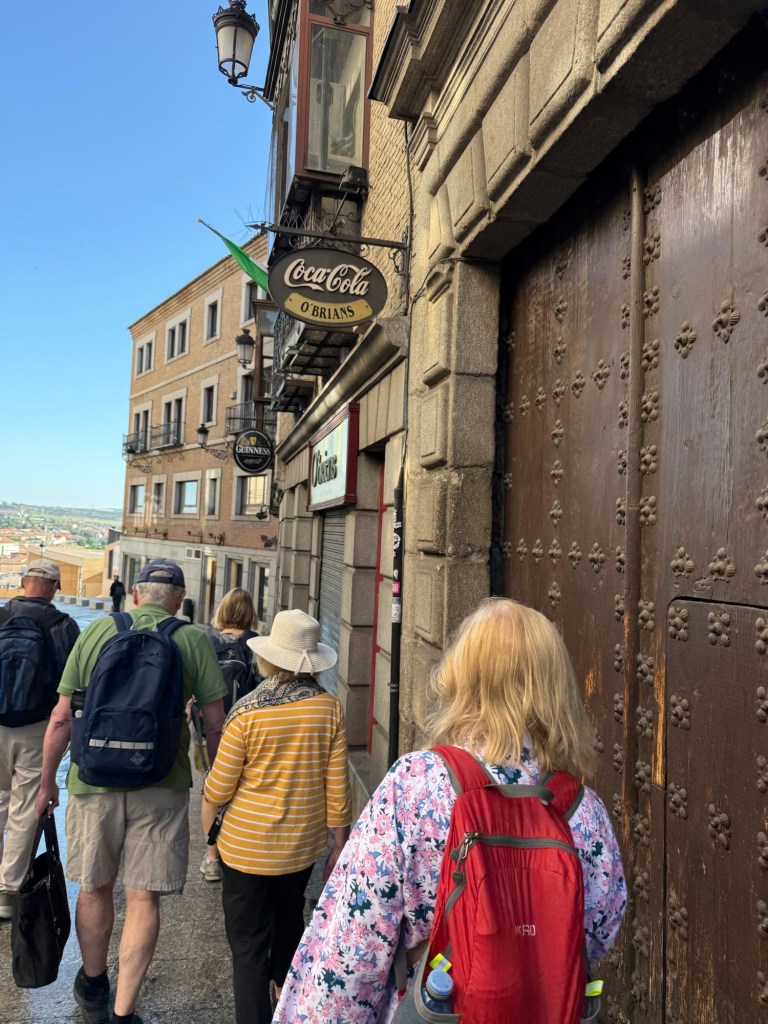
Time to say goodbye to Toledo, thankfully without rolling our bags, a van picked them up for us!
Our journey through Spain has been like flipping pages in a storybook—each stop revealing a different chapter of the country’s landscape, culture, and soul. We began in the colorful energy of Barcelona, moved through the royal richness of Madrid, and stood beneath the soaring aqueduct in Segovia. Toledo welcomed us with its medieval walls and tangled alleys. Now, we’ve reached the wide, open plains of La Mancha—a land made famous by windmills and one wildly idealistic knight.
This marks roughly the halfway point of our two-week trip, and the scenery is beginning to shift. We’ve left behind the forested hills and castle towns of central Spain and entered a drier, flatter stretch of farmland where wind and wheat shape the skyline. Javier, our guide, explained that Spain is divided into 17 autonomous regions (similar to states in the U.S.), and we’ve already passed through several: Catalonia, Madrid, Castile and León, and Castile-La Mancha. Today we are deep in the heart of Castile-La Mancha, a region known for its Manchego cheese, sprawling vineyards, and—of course—its windmills.
Don Quixote Comes Alive
During our morning bus ride, Javier gave us an introduction to the literary icon who defines this region—Don Quixote. He asked, “Did any of you read Don Quixote growing up?” For Spaniards like Javier, Cervantes’ tale is required reading. He said, “Just promise me that someday, you’ll read the first 80 pages.” He gave us just enough of a summary to get our minds wrapped around the story: a middle-aged man, obsessed with old tales of knighthood, decides to become a wandering knight himself. He renames himself Don Quixote and sets off on horseback to right wrongs, accompanied by his loyal but skeptical sidekick, Sancho Panza. The windmills? He mistakes them for giants and charges at them with his lance.
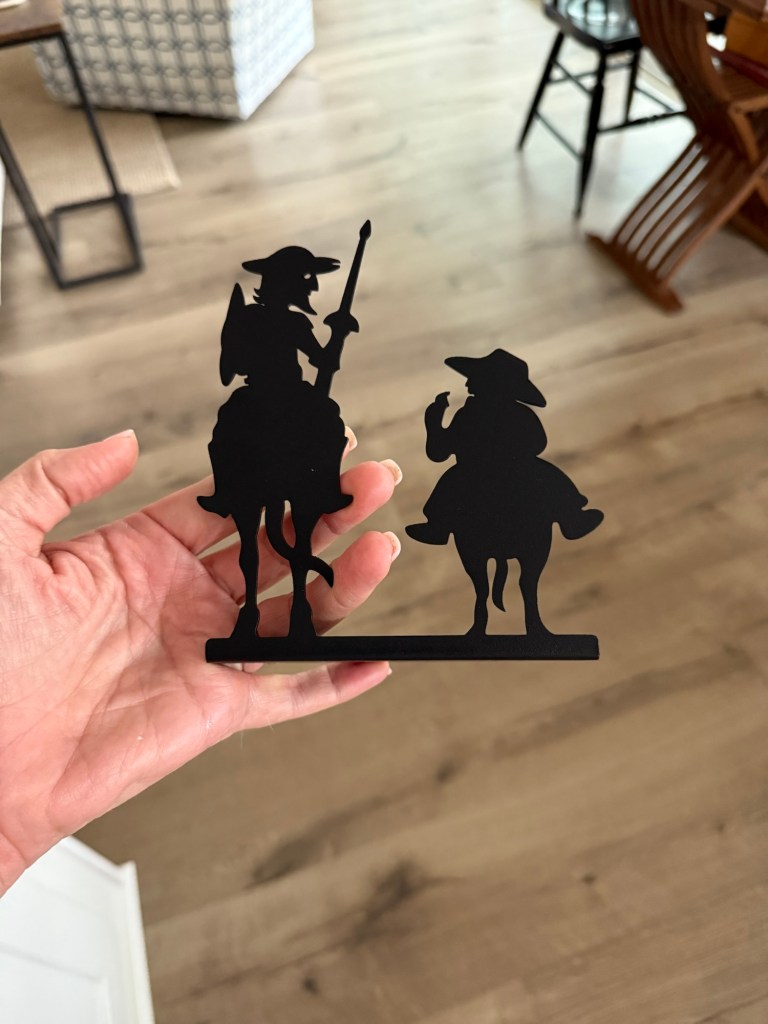
Javier told us those early pages are where the heart of the novel lies—humor, imagination, and a deep commentary on reality versus illusion. As he spoke, a memory clicked. The only thing I knew about Don Quixote before this trip was a sketch that hung in my childhood home—a Pablo Picasso rendering of the knight and his companion. I never really understood what it meant until now. The fact that Picasso himself was Spanish just adds another layer to it.

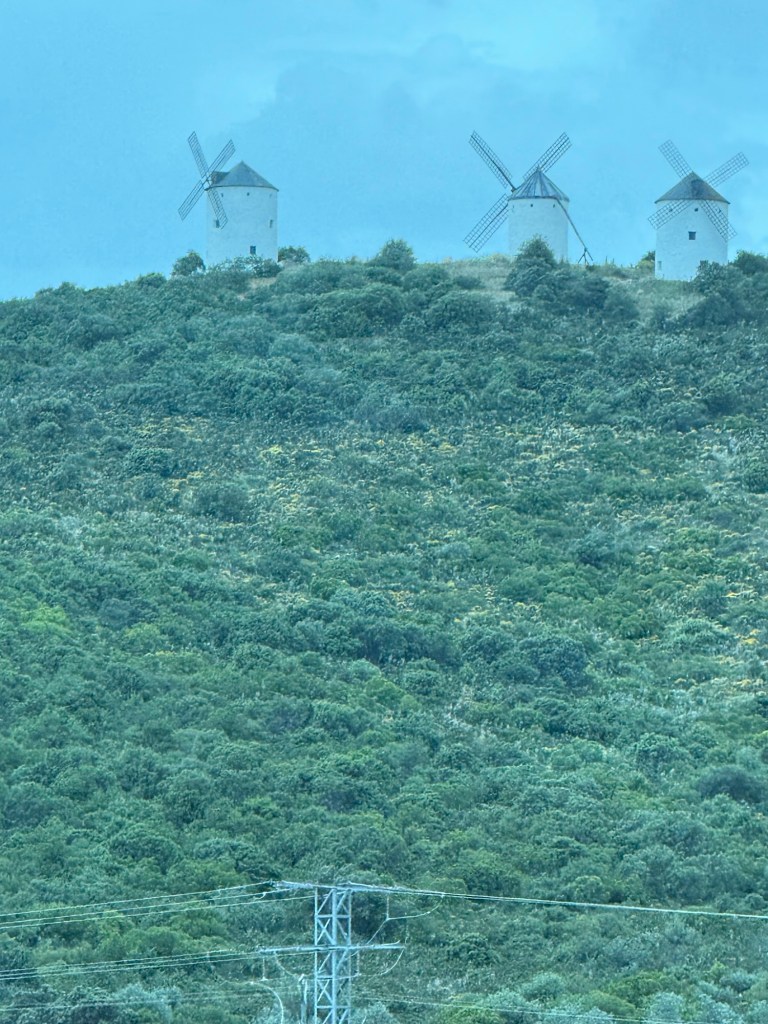
We arrived in the town of Consuegra, where a row of white windmills stretches across the Sierra de la Calderina.
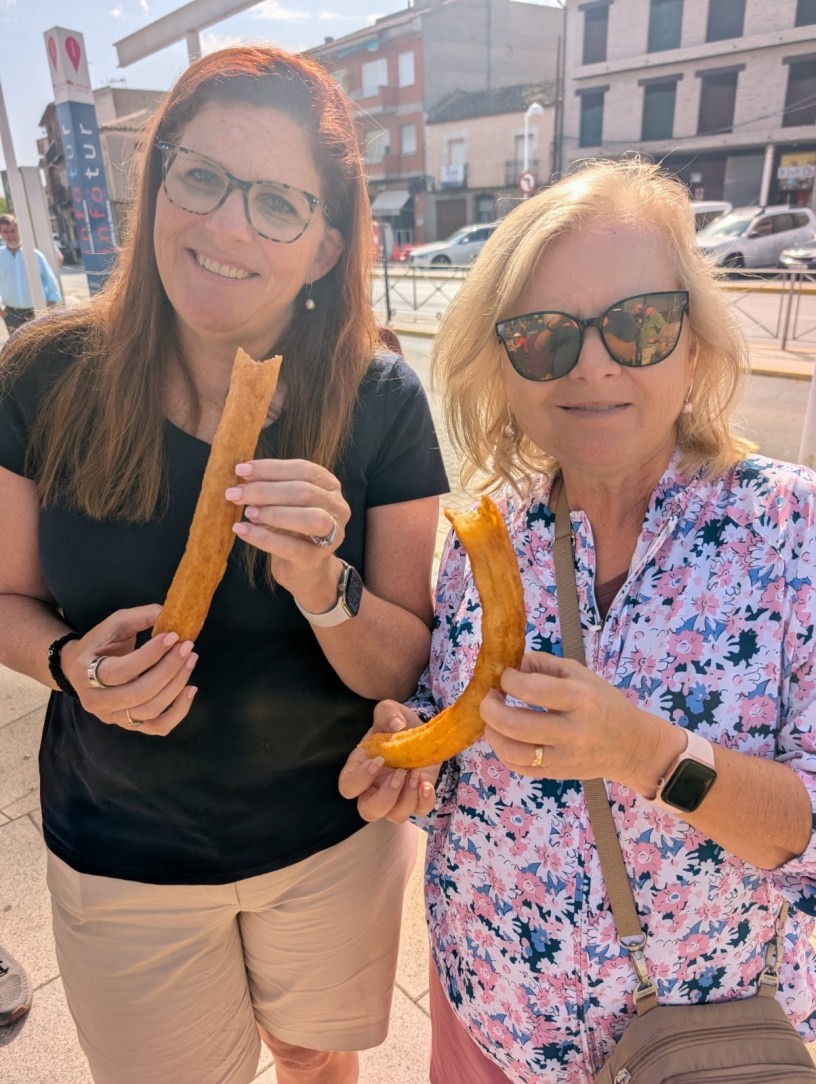
But before heading up the hill, we made a quick stop at the base of town in Casa Herrera for a bathroom break—and a surprise churro treat from Javier, who knew lunch would be later than we’re used to.
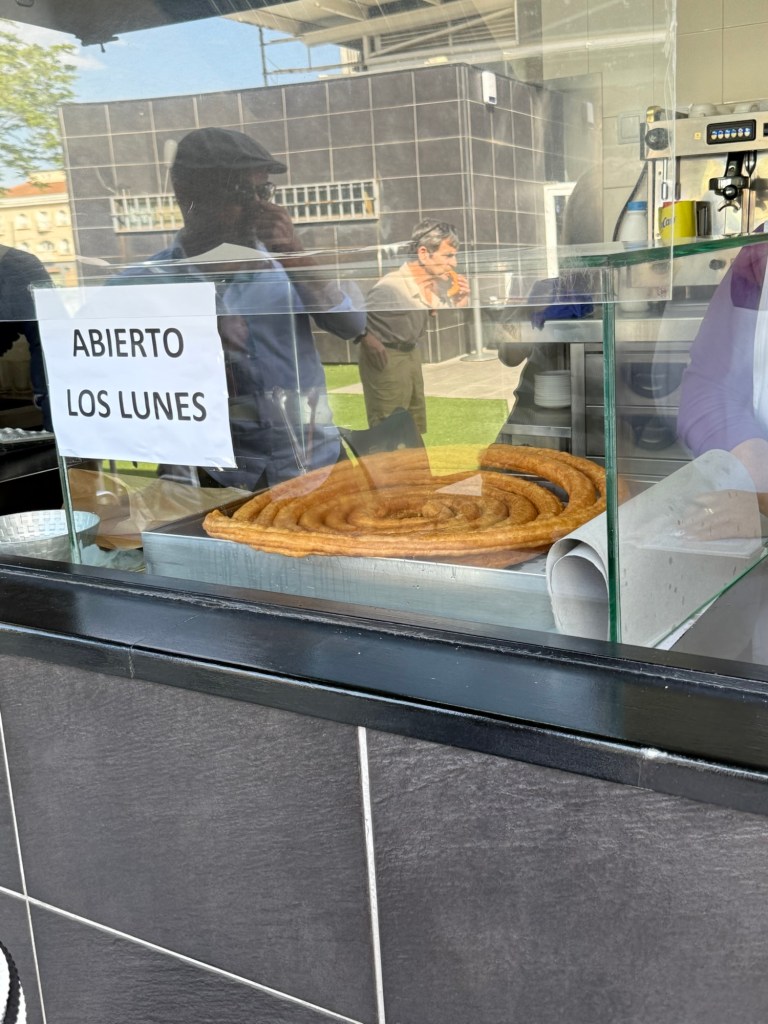
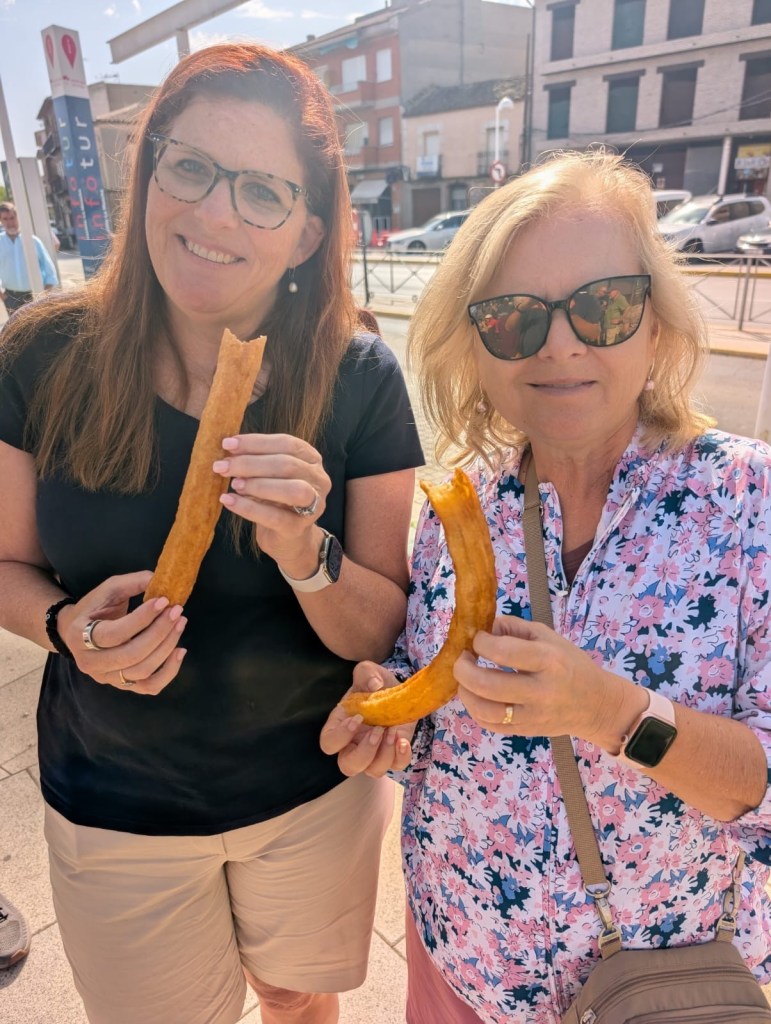
It was also here that our local guide joined us, giving us background on the town as we zigzagged up the hill: its bullring, its church, and the significance of these iconic mills.

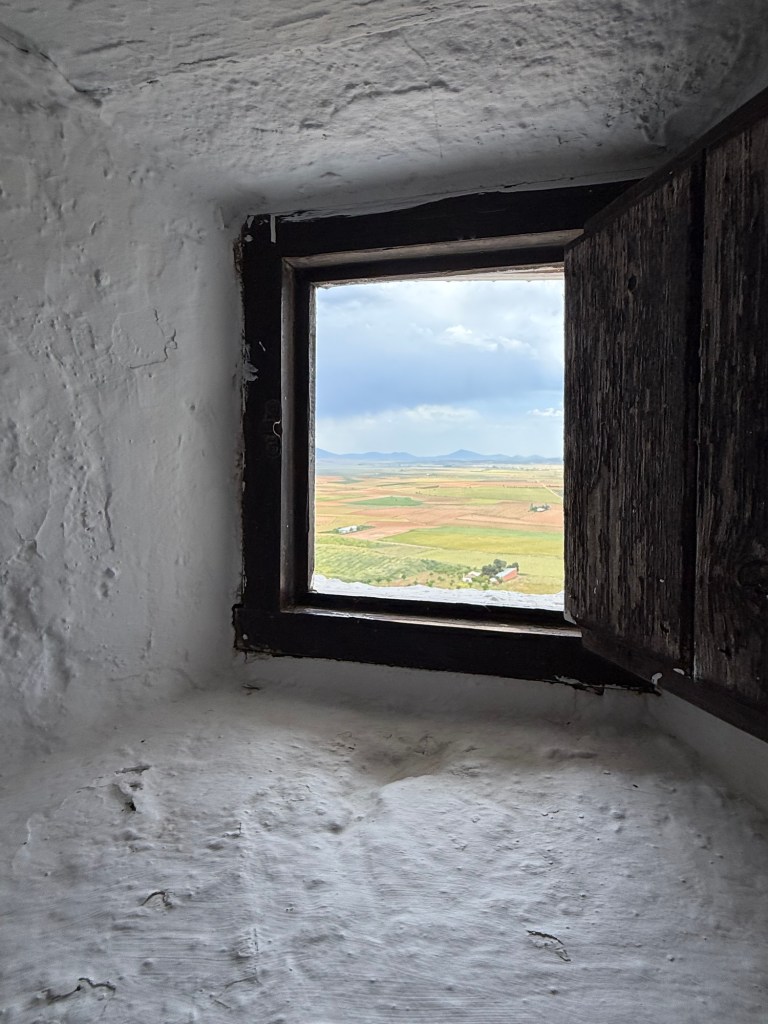
Standing at the top, the view stretched endlessly. These weren’t the decorative windmills I saw in Amsterdam the previous fall—those were used for managing water levels. Here in La Mancha, the windmills were practical tools for grinding grain.
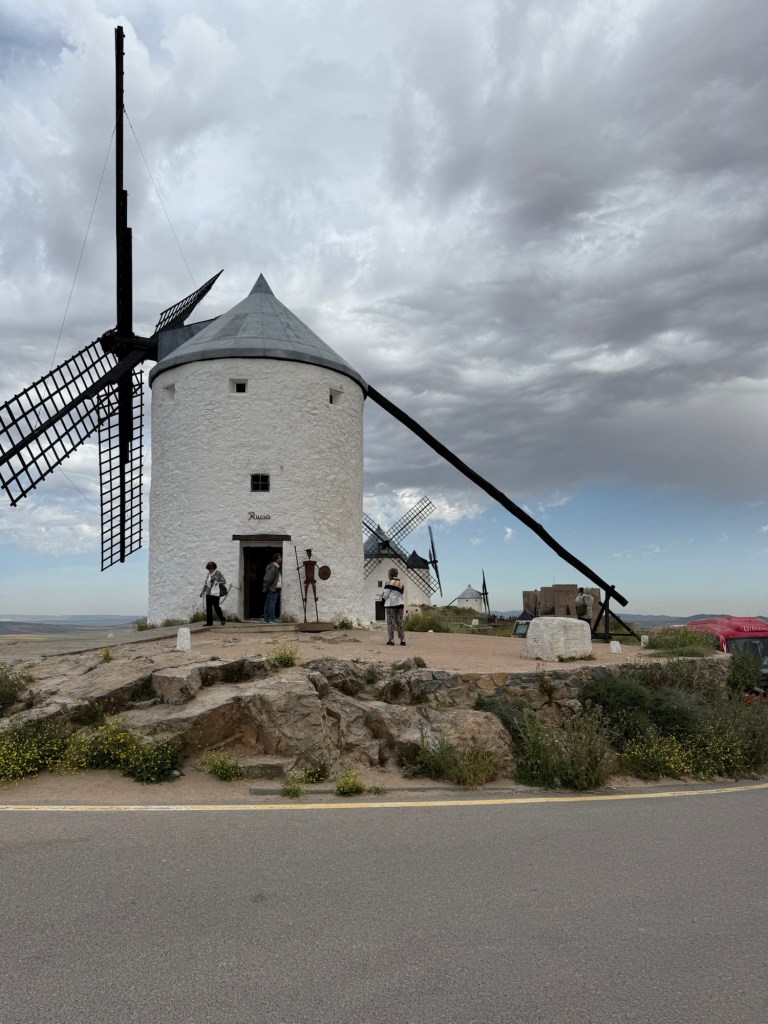
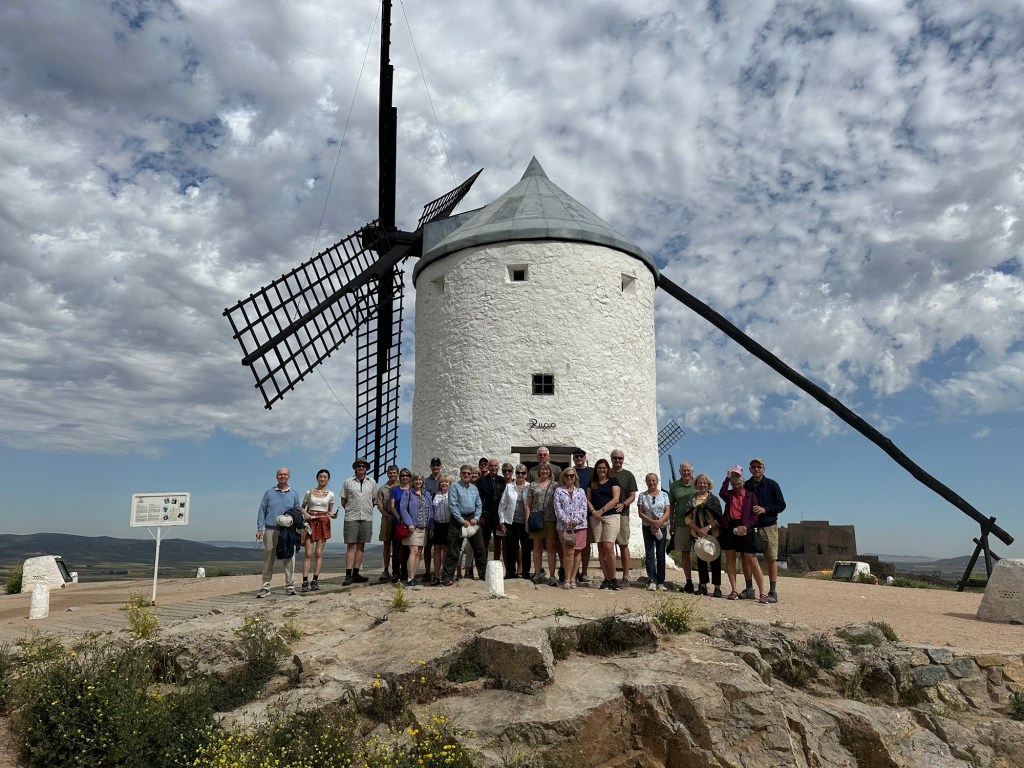
Our guide walked us through one of the mills and explained how the upper stone could be raised or lowered to adjust the grind depending on the grain—whether it was wheat, corn, or barley. She showed us the gears, the millstone, and how the flour byproduct was collected below.
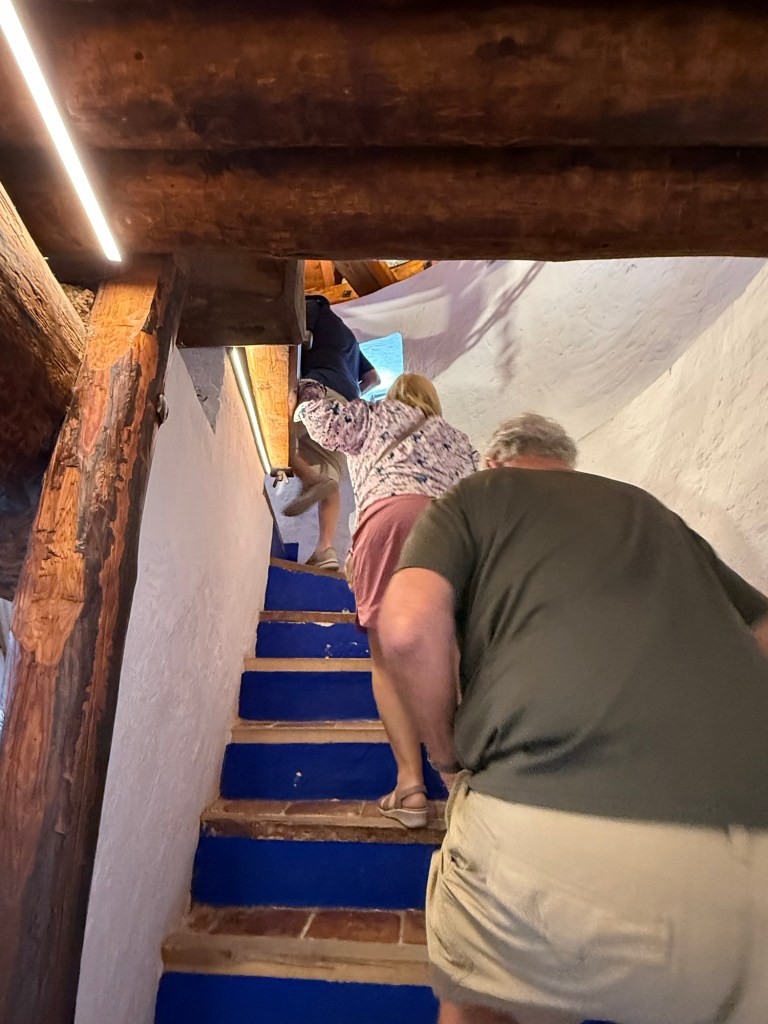
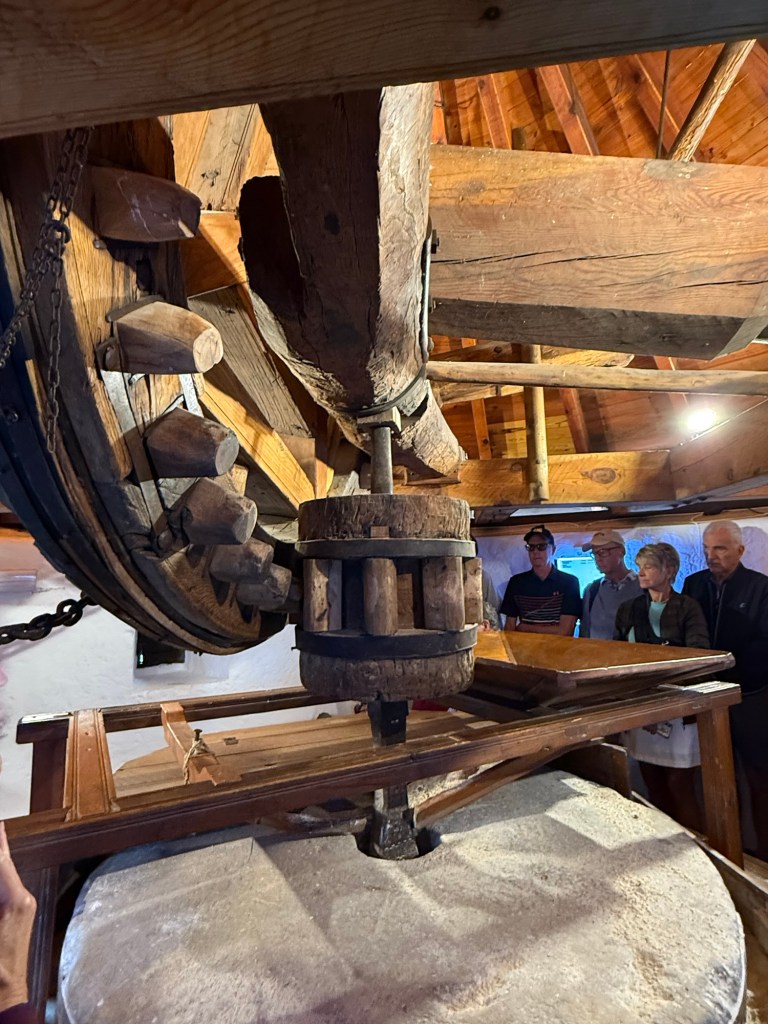
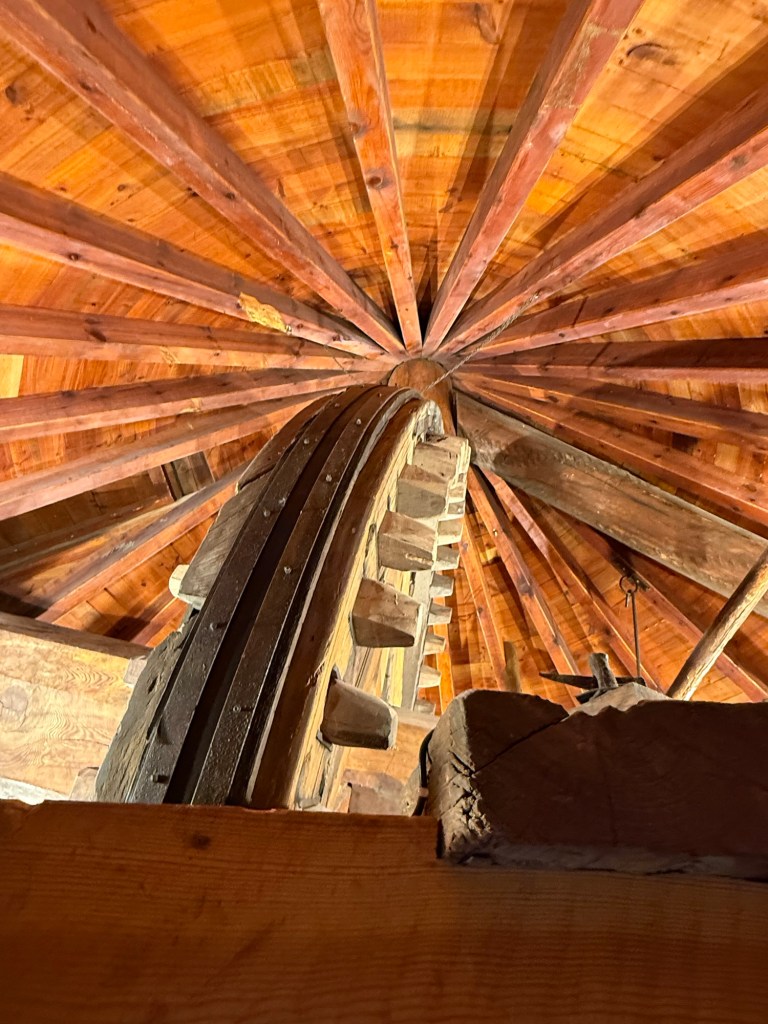
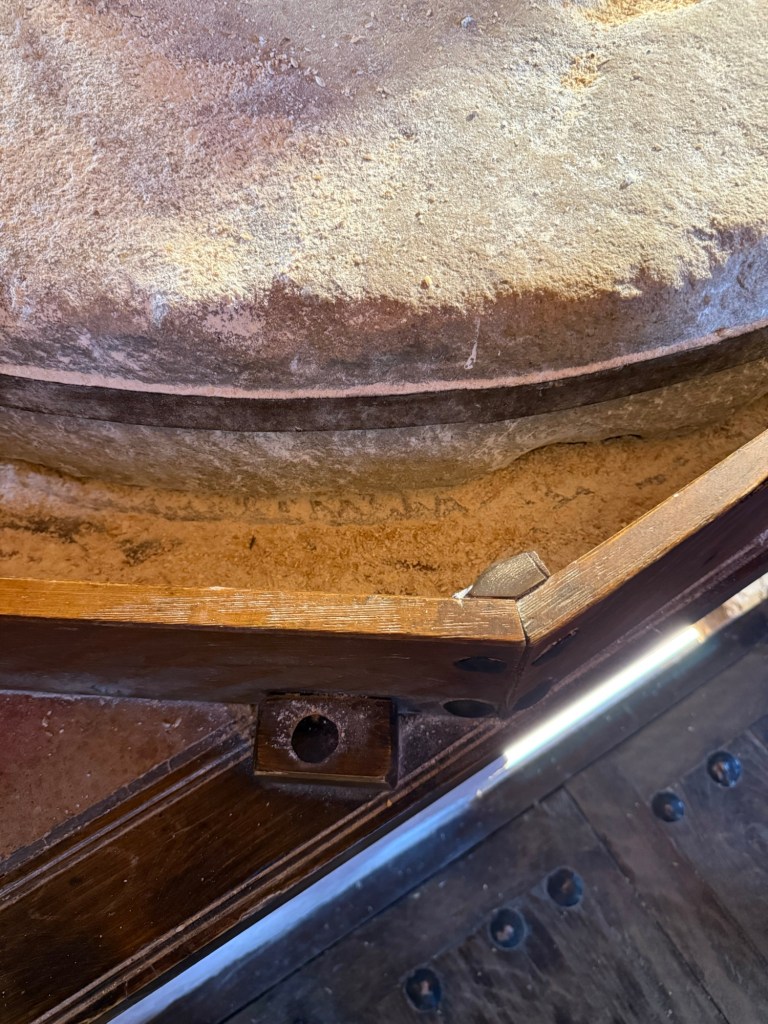
The design was brilliant—at the very top, the windows helped the miller determine the wind’s direction, and I found myself waiting for her to ask, “Which way is the wind blowing?” I was ready with the answer. My dad trained us as kids to pay attention to the wind—he would’ve been proud.
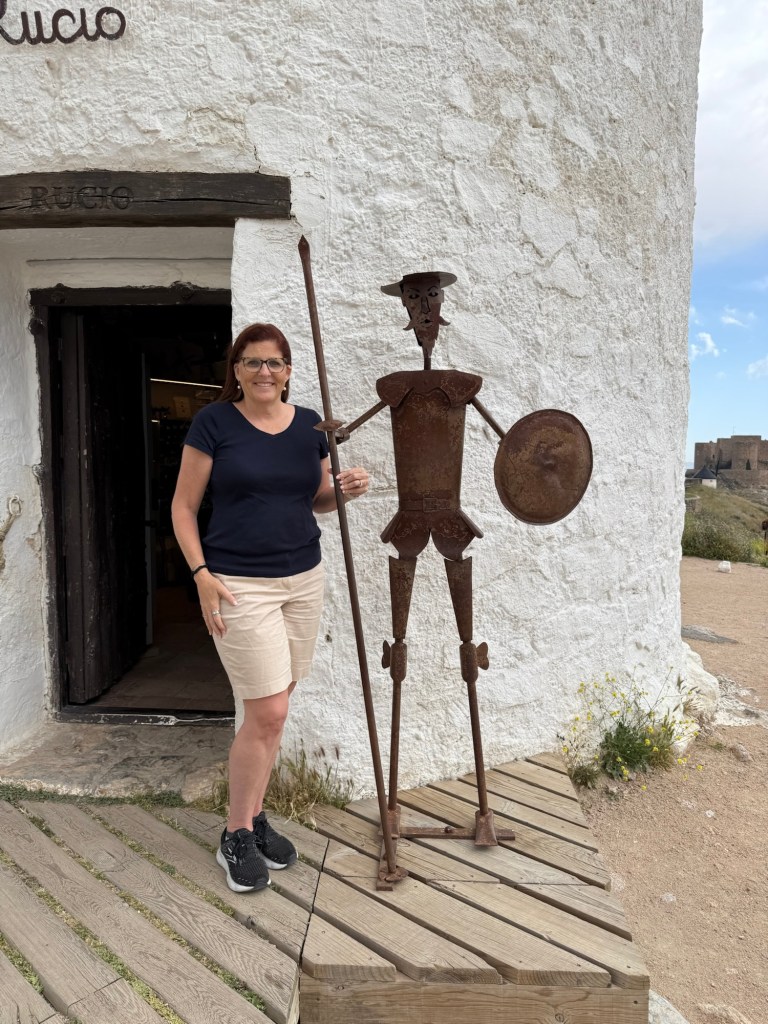
As we descended the narrow wooden stairs, we passed through a tiny gift shop built into the windmill itself. That’s where I spotted a small metal replica of the very Picasso sketch I’d grown up with. I had to have it—a perfect keepsake to remember the day Don Quixote finally made sense.
A Pop-Up Picnic with Manchego & Wine
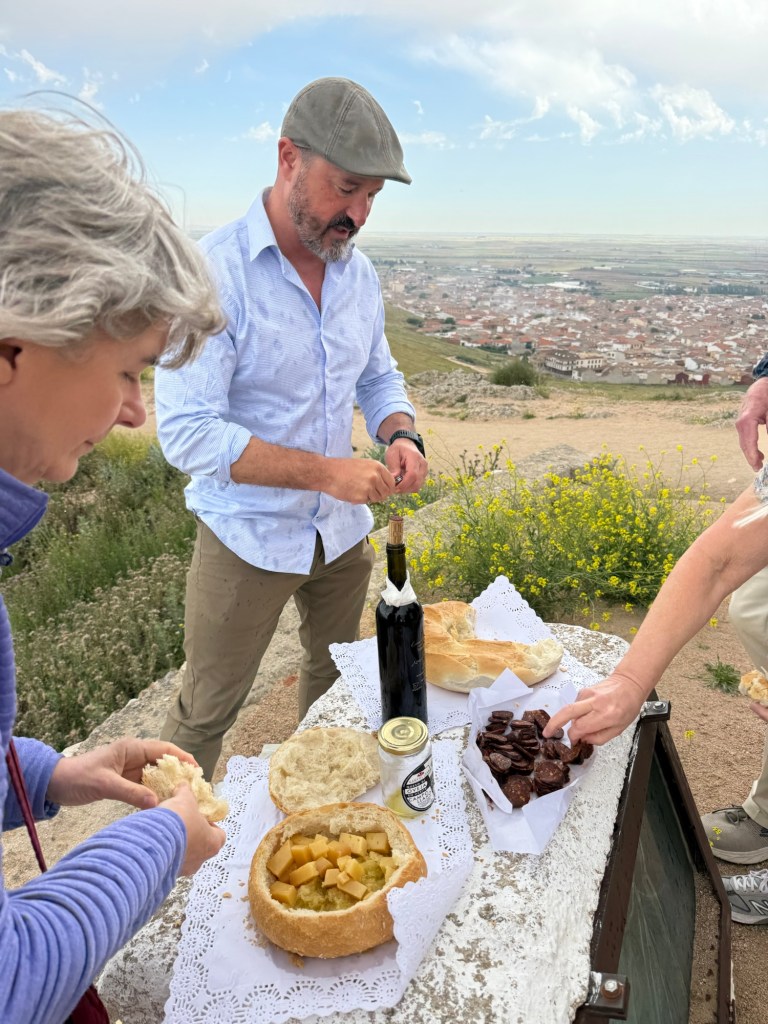
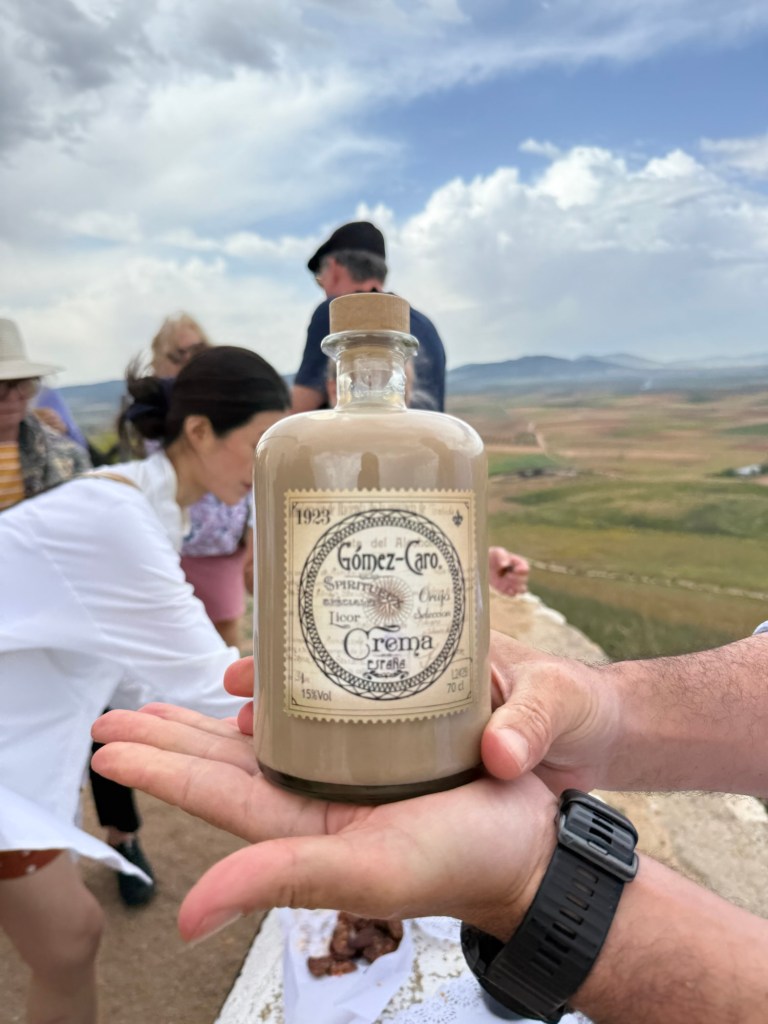
Back on the hillside, Javier surprised us again—he had set up a pop-up picnic right there on a stone ledge overlooking the plains. He poured olive oil into a rustic bread bowl, nestled beside cubes of rich Manchego cheese. We tore pieces of crusty bread to dip and used toothpicks to try the cheese and more of the delicious venison chorizo we first tasted the day before. To top it off, we raised glasses of local wine in a group toast. And just when we thought the experience was done, he handed each of us a creamy Spanish liqueur—smooth, sweet, and impossible not to smile over.
Puerto Lápice: The Charming Quixote Village
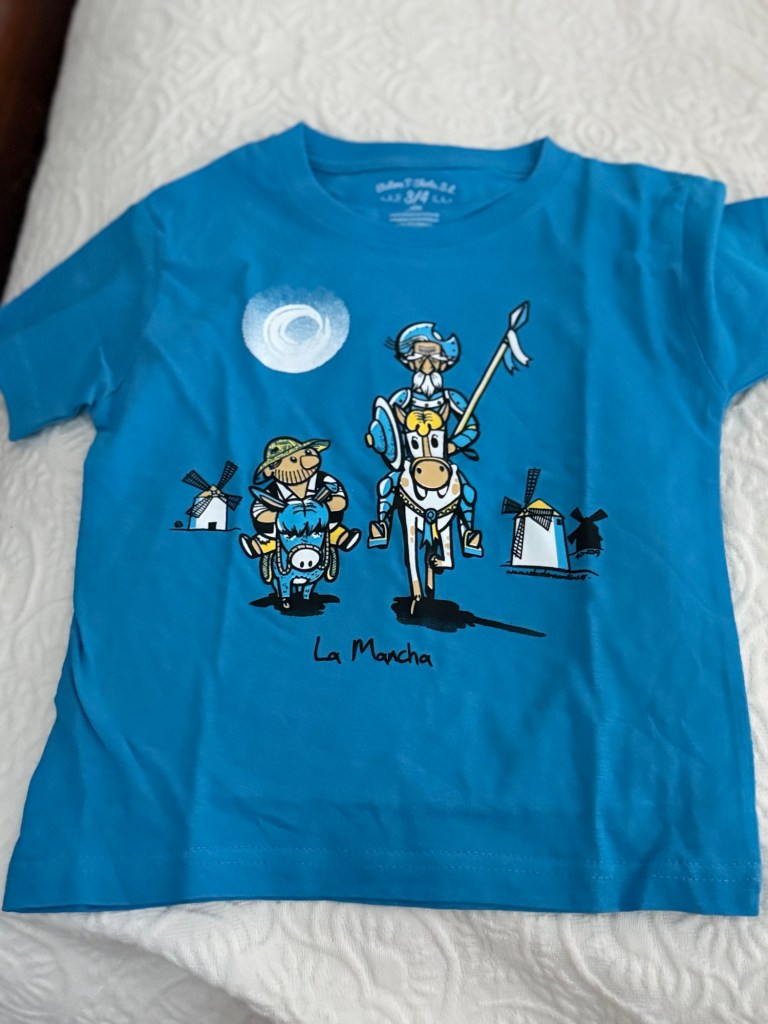
From there, we traveled a short distance to the nearby village of Puerto Lápice, a postcard-perfect stop full of Don Quixote charm. This is where we’d enjoy our group lunch, but first we had some time to shop and he said get the saffron! I did plus some cute matching T-shirts for my grandsons.
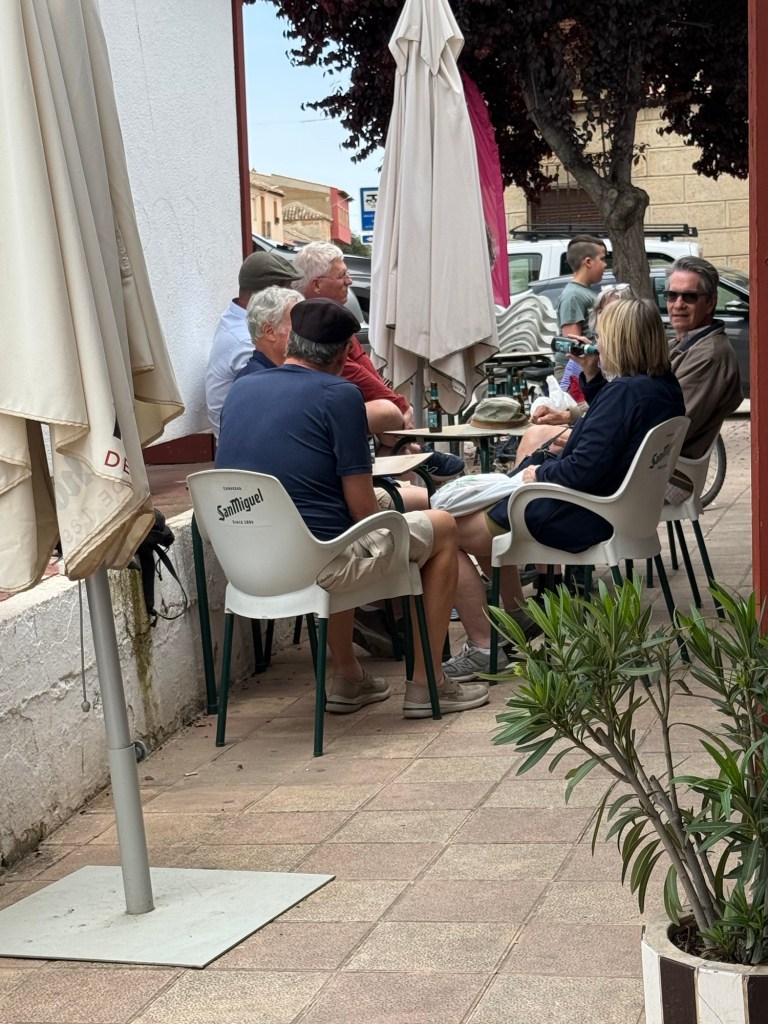
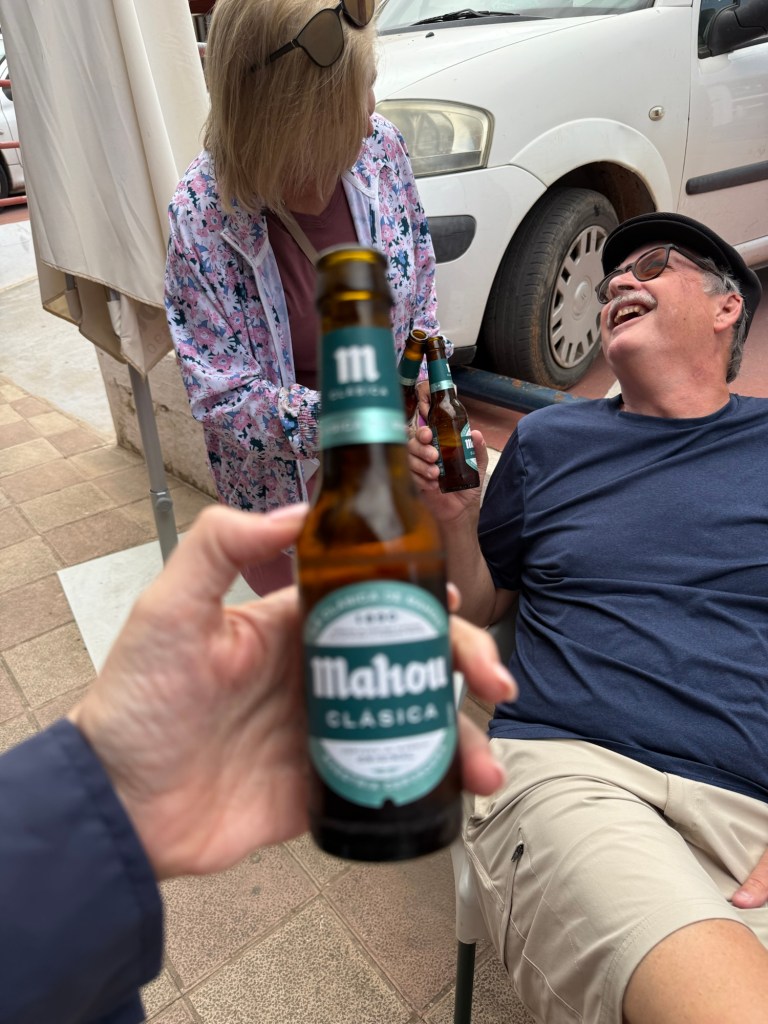
Javier offered to take anyone interested to the local tavern for a small bottled beer while we explored. The guys took him up on it, and after we wandered through the shops and snapped a few photos, we joined them for a round.

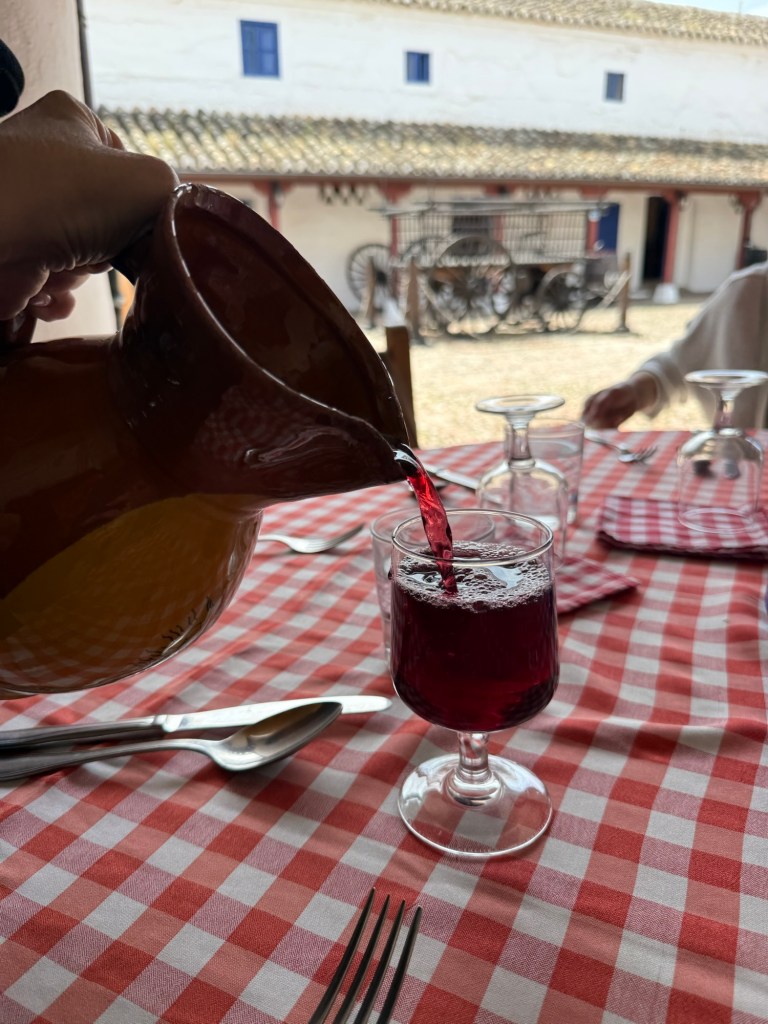
Lunch was served in a shaded courtyard and felt like a true La Mancha experience—Manchego cheese, roasted meats, local vegetables, fresh bread, and wine. The setting was relaxed and festive, with laughter echoing through the patio and plates being passed around. I’ve included a few photos below that show just how beautifully it was all presented.

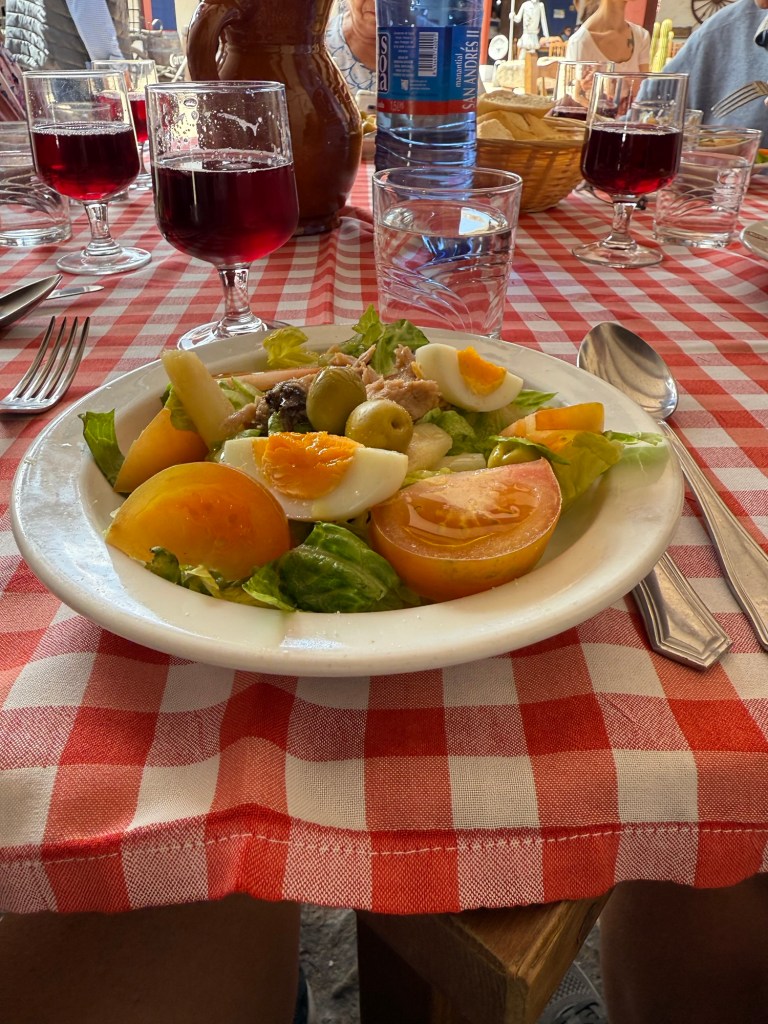
Ensalada Mixta — a staple on Spanish tables, with crisp greens, tomatoes, tuna, hard-boiled egg, and olives, all drizzled with local olive oil
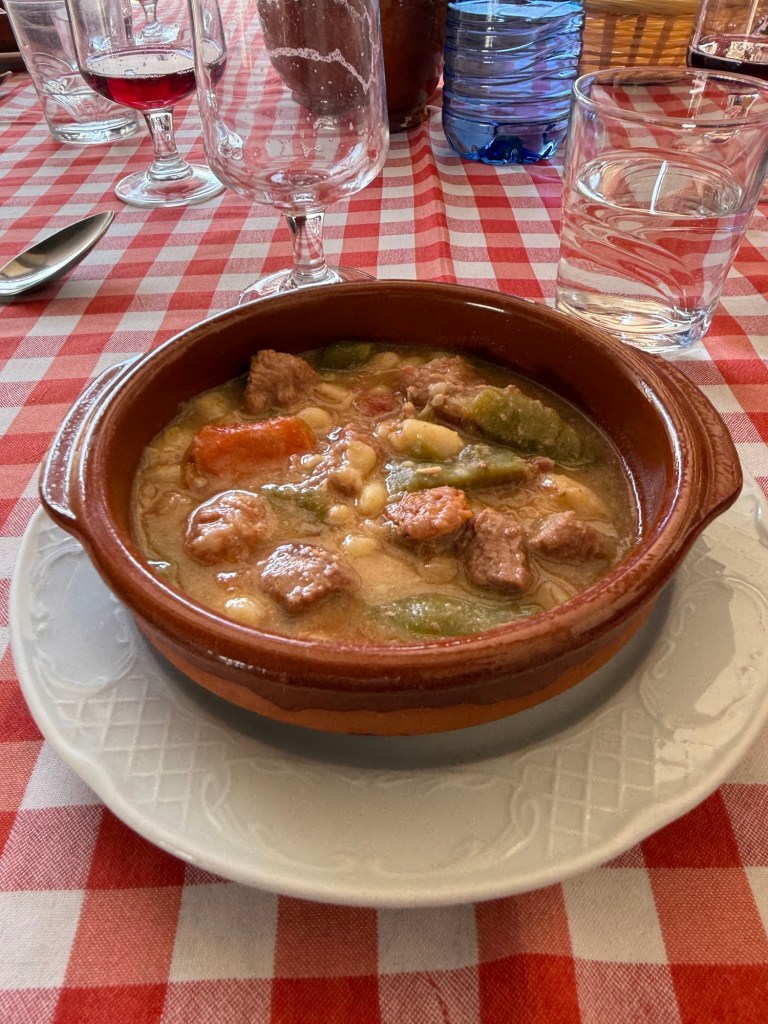
This is a traditional Castilian meat stew made with beef or pork, potatoes, carrots, sometimes peas or green beans, and slow-cooked in a richly seasoned broth with garlic, paprika, and bay leaf.

Javier brought the tool used to make our dessert. A traditional fried pastry, pressed into hot oil using this flower shaped mold then dusted with sugar and cinnamon.


As we climbed back onto the bus, full and happy, we made our way south toward Granada, where the next chapter of this story awaits.
 Happiness is Possible