
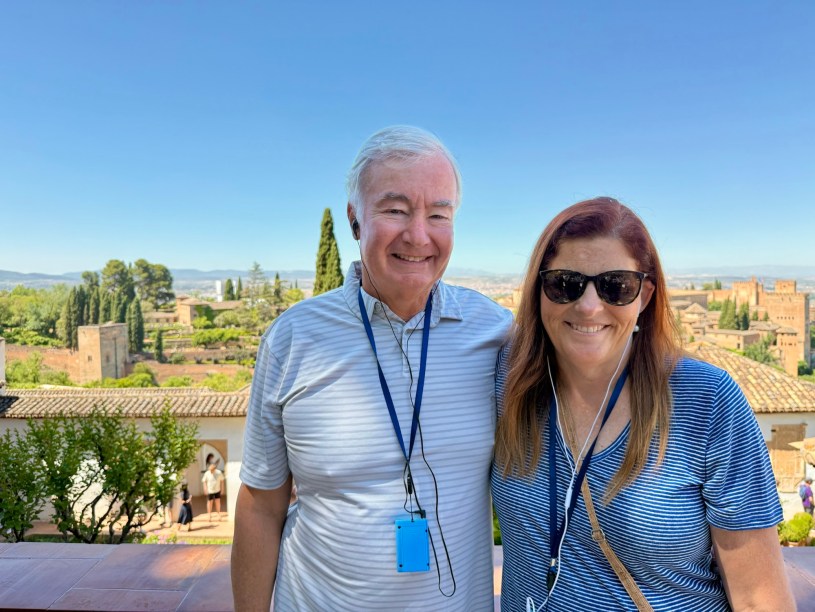
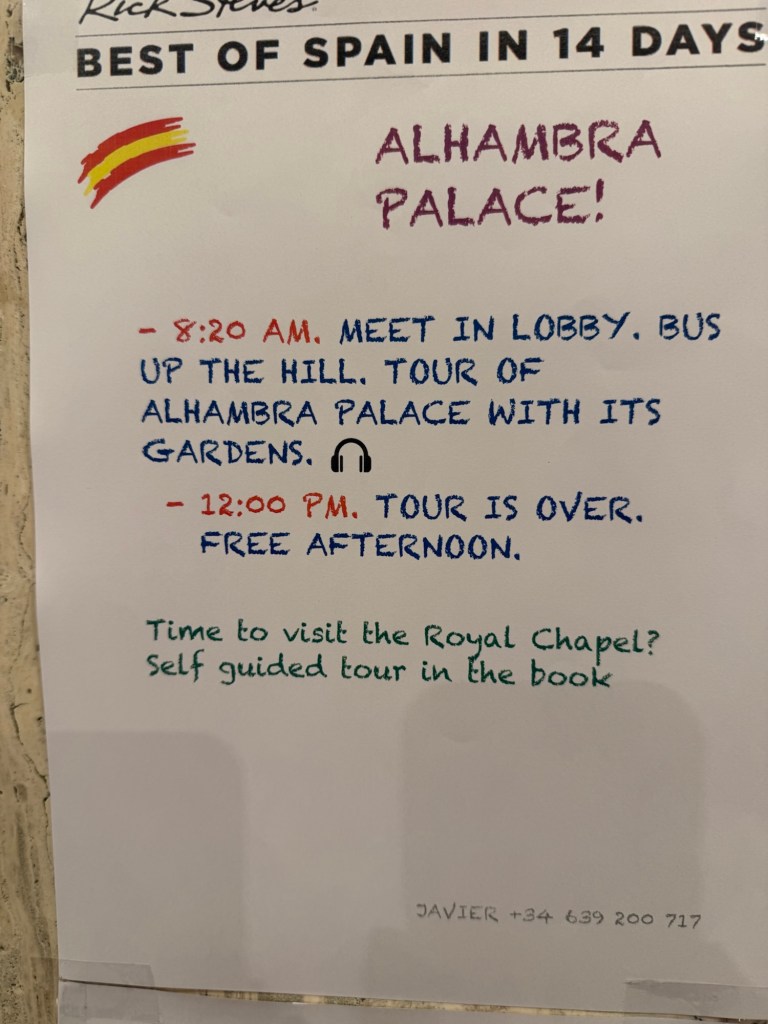
We met outside the hotel and walked together to catch a small local minibus that would take us up the steep hill to the Alhambra.
Side note for anyone walking around Spain: Watch for bike lanes. They’re everywhere—often subtle—and packed with scooters and cyclists who definitely have the right of way. Javier warned us early: “Don’t stand in the bike path!” He also told us to wait for the green pedestrian signal, which in Granada is a little running man. From then on, we’d joke: “Quick! Follow the running man!”
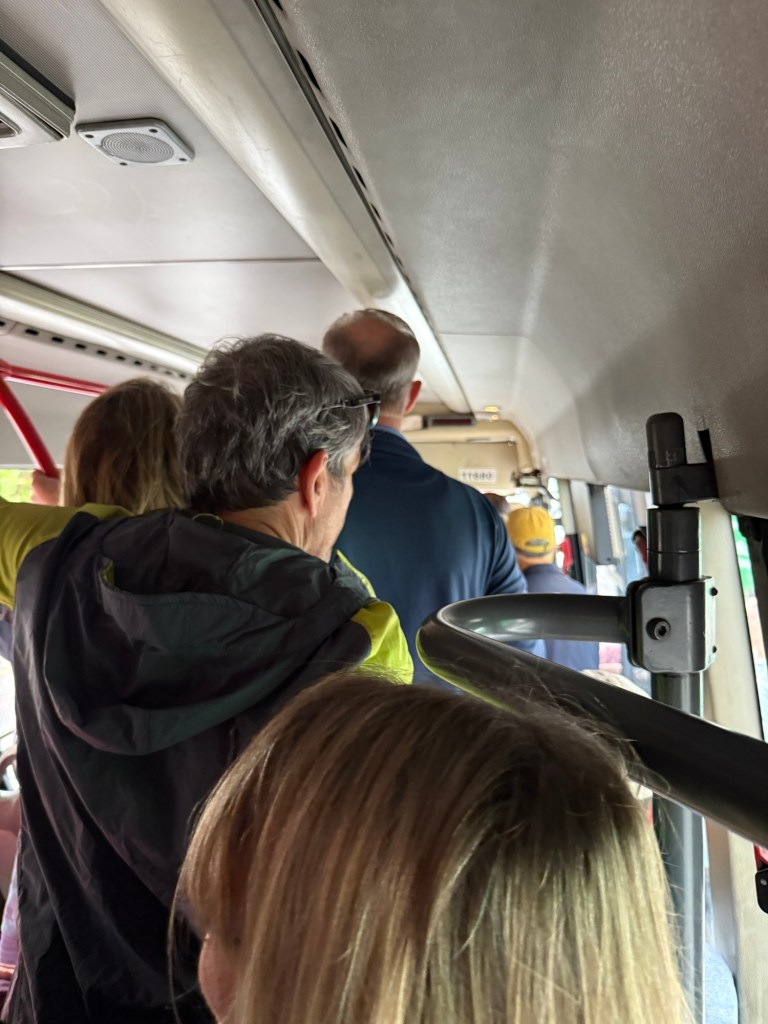
🚐 The Minibus: What Have We Gotten Ourselves Into?
At first, the bus looked nearly empty, so we headed to the back. Lenore and I were literally standing on the steps of the back door. We assumed the driver would stop boarding once it was full.
We were wrong.
With every stop, more people crammed in—four or five at a time. We kept wondering where they’d fit. I don’t know the actual capacity, but we definitely exceeded it. Still, it got us up the hill. And it gave us one of those funny, local experiences we’ll never forget.

🕌 The Grand Entrance & Overlook
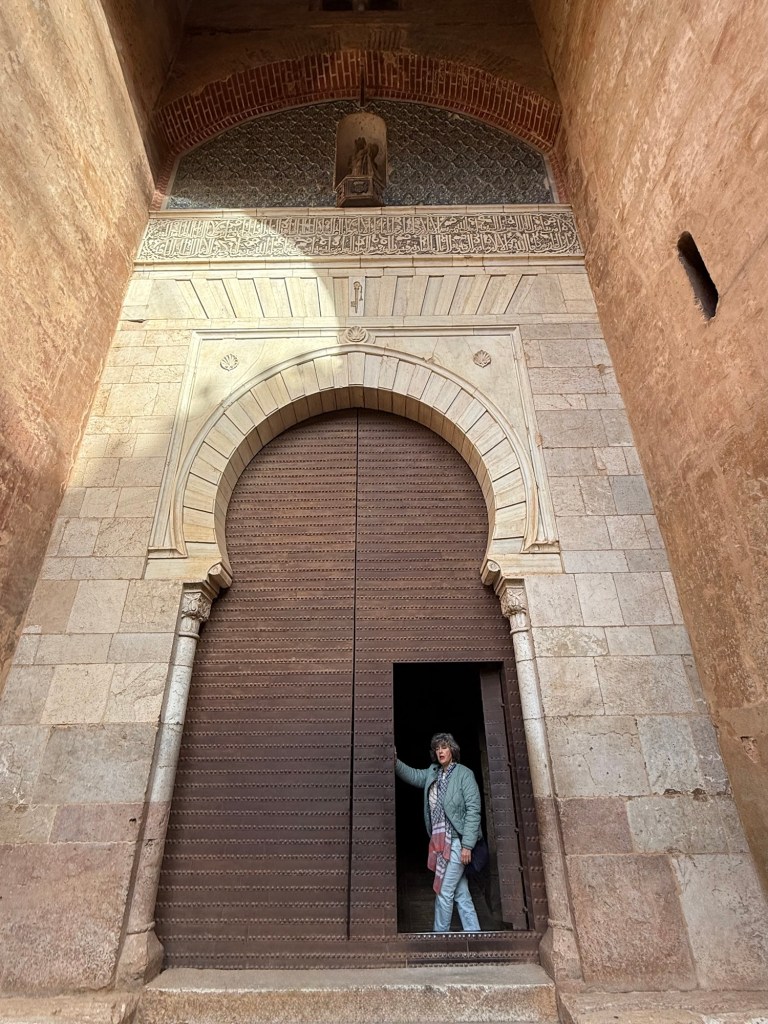
Our tour began at the main entrance to the Nasrid Palaces—marked by a massive wooden door within a Moorish arch. Arabic inscriptions and intricate plasterwork made it clear we were about to enter a sacred space. A Christian statue above the arch, added later by the Catholic Monarchs, reflected the Alhambra’s layered history.
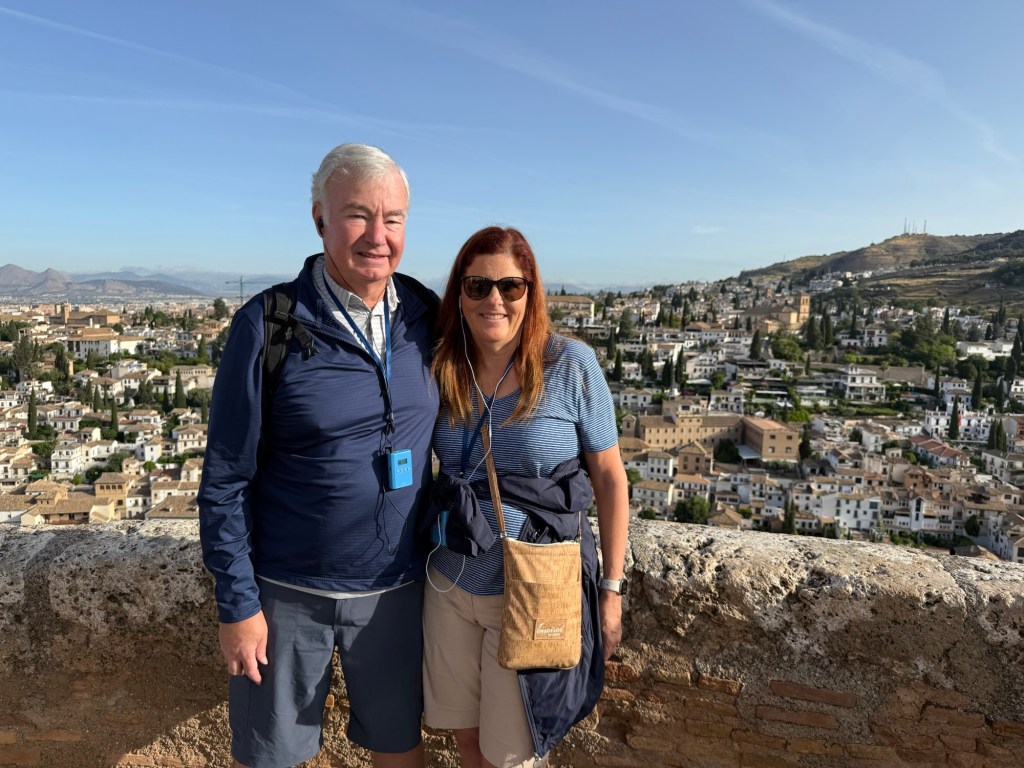
Just beyond, we paused at a scenic overlook. Granada and the whitewashed Albaicín district spilled out below. No wonder this fortress was built here—it watches over everything.
🪨 A Fortress First
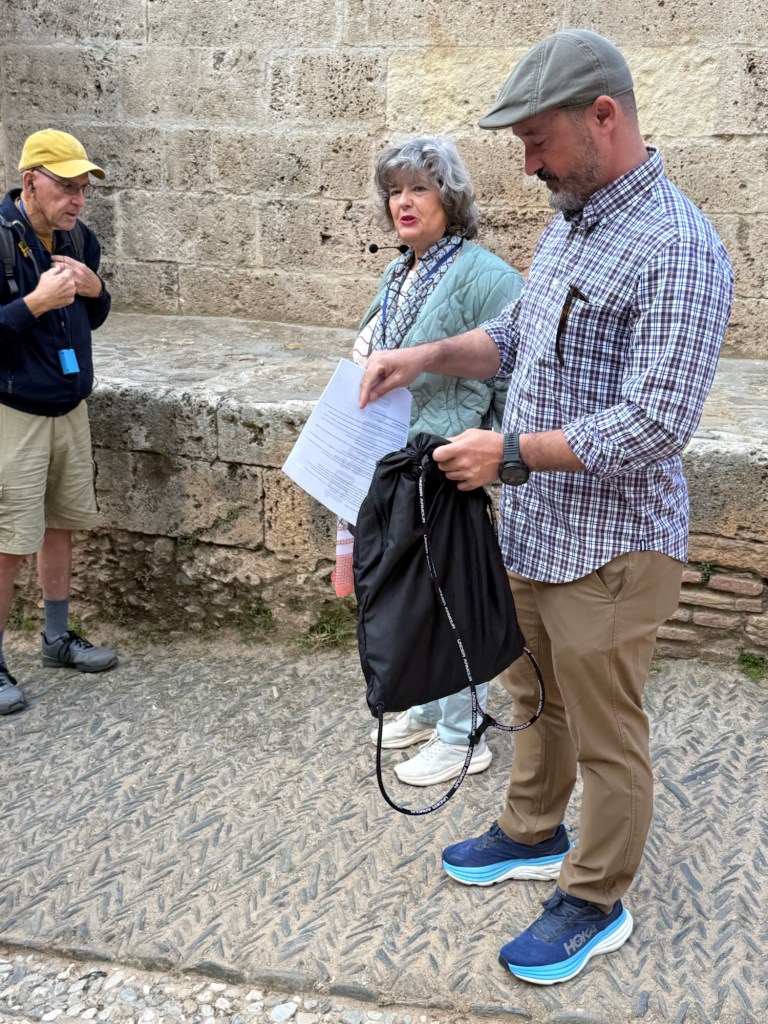
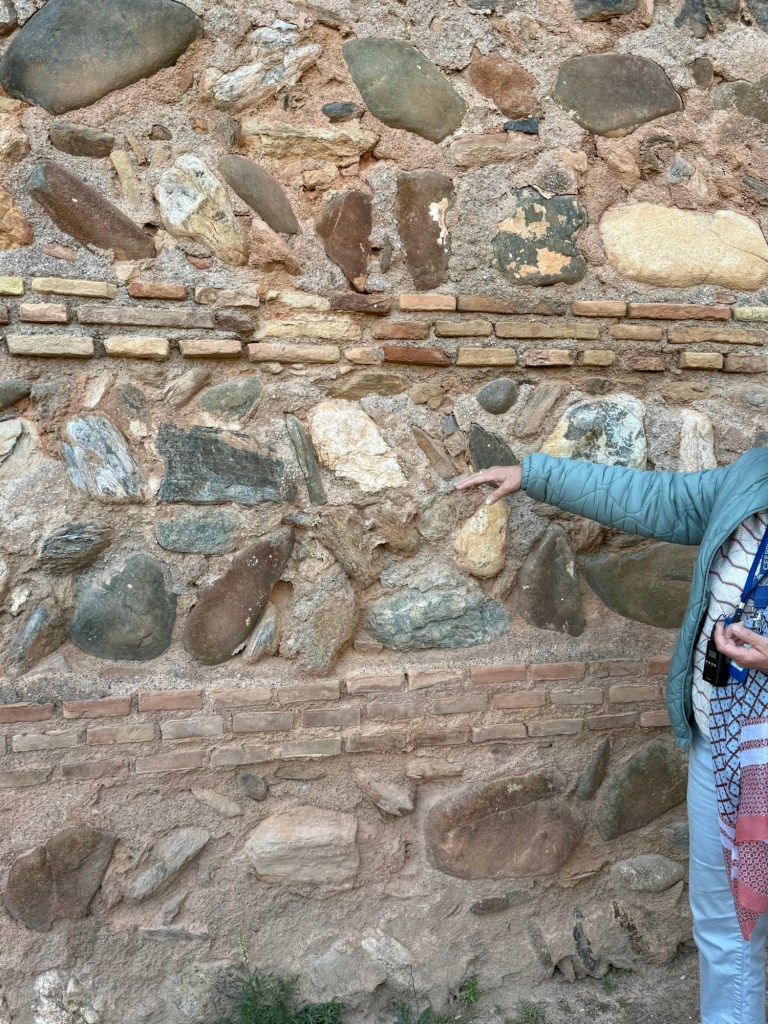
Our guide paused by the rough stone outer walls—nothing decorative, just solid, embedded masonry. It was a reminder: before the art, the Alhambra was built to defend.
🏘️ Barrio Castrense – The Workers’ Quarter
Built: c. 1238 by Muhammad I of the Nasrid Dynasty
Purpose: Military housing and service support
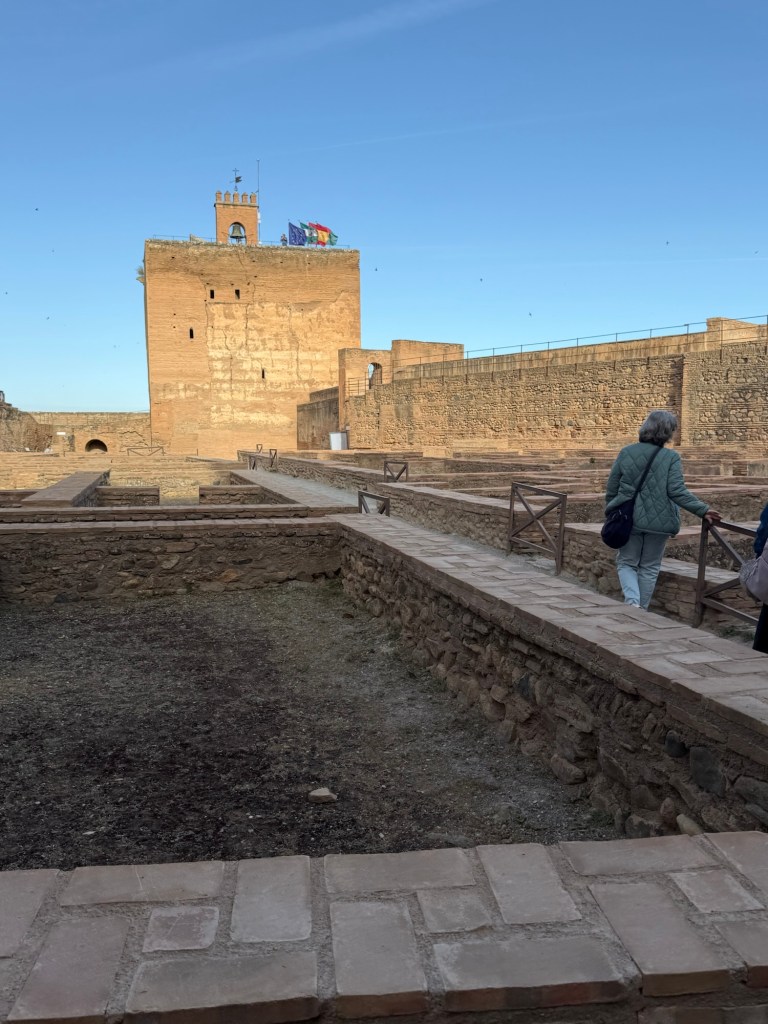
Next, we entered Barrio Castrense, where soldiers, blacksmiths, cooks, and other staff once lived. This was the palace’s support system for over 250 years, until the fall of Granada in 1492.

🌿 Garden Path & a Glimpse Toward Africa
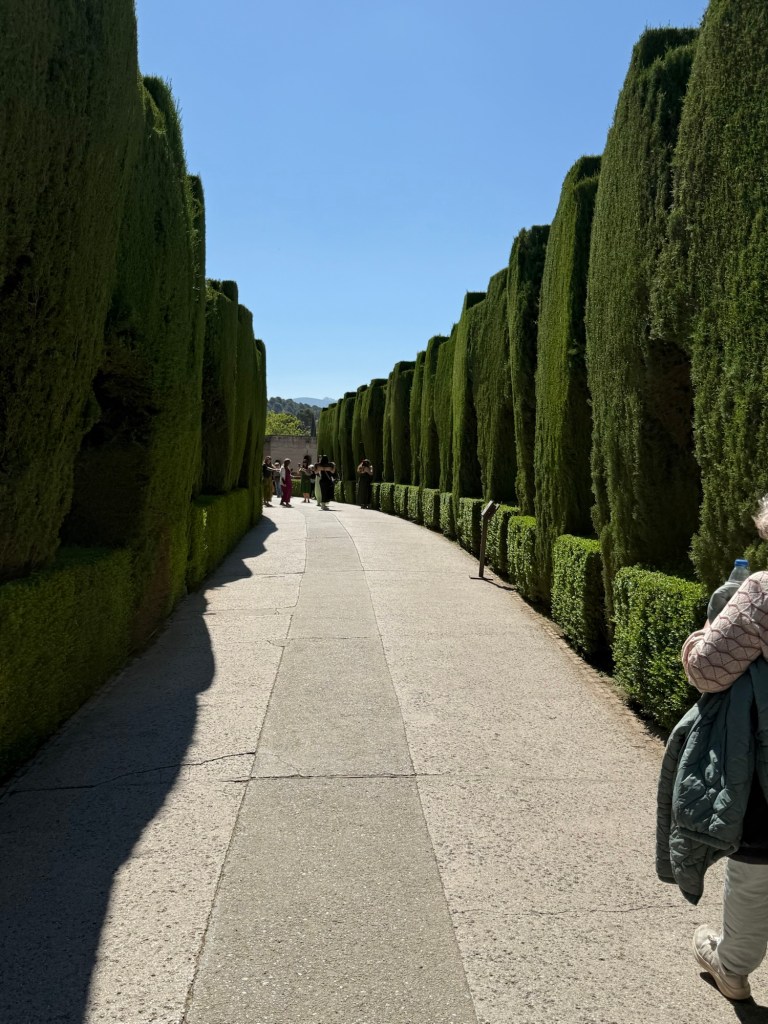
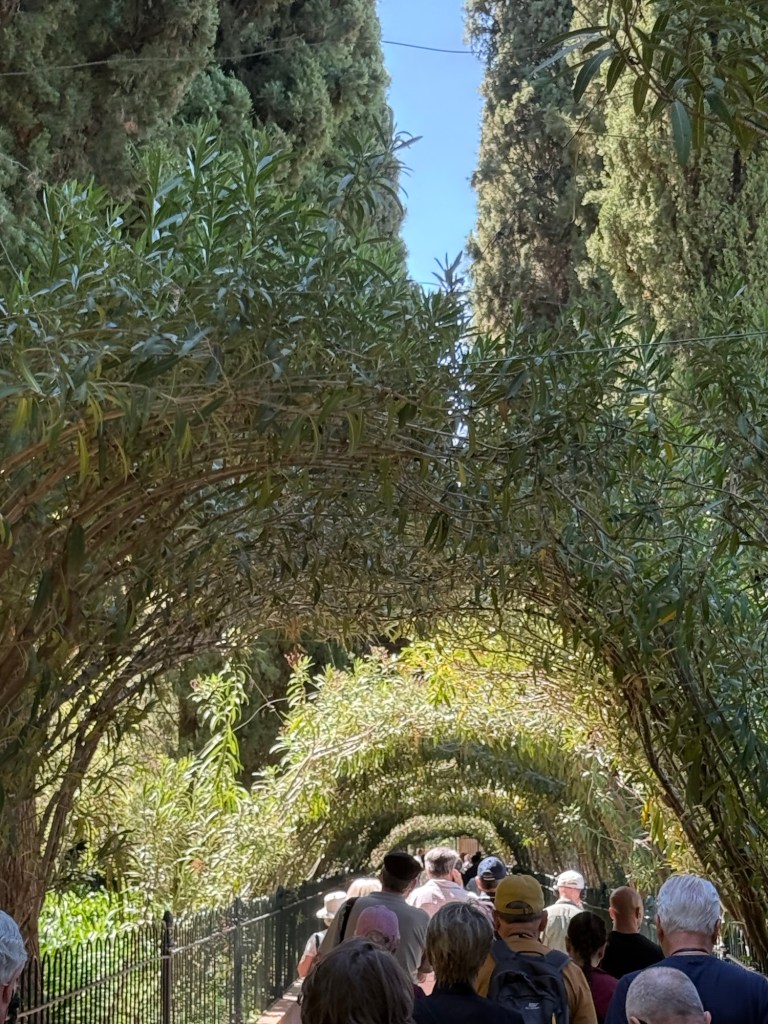
We followed a garden path lined with roses, sculpted hedges, and cypress trees. Everything felt calm and perfectly placed.
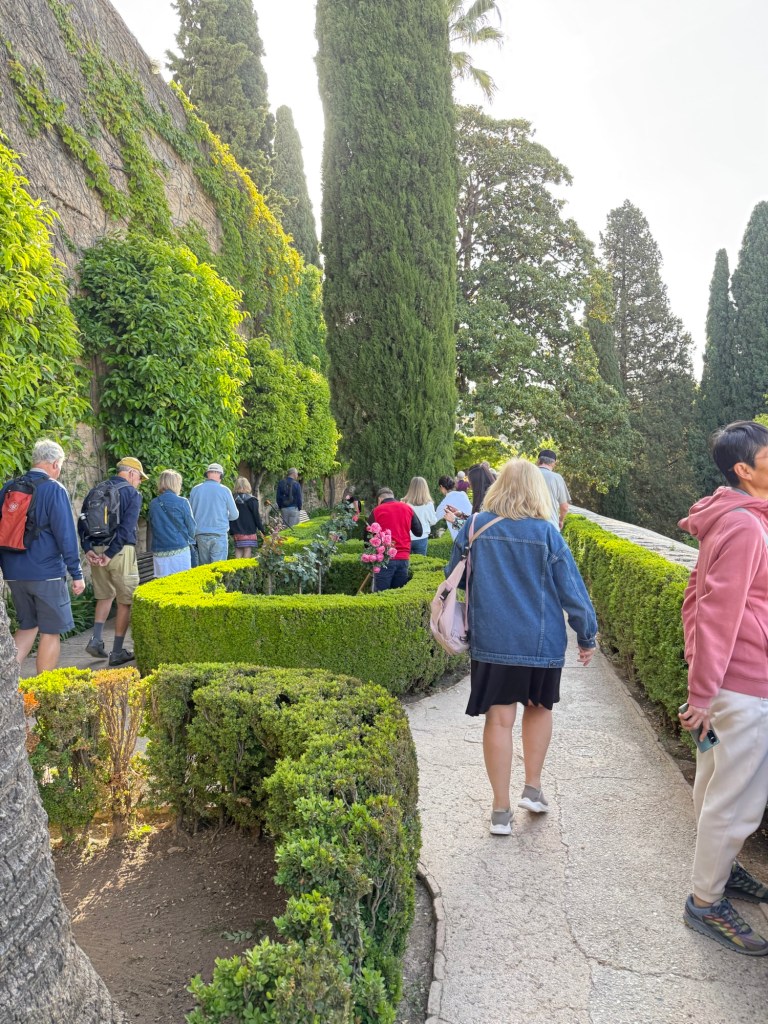

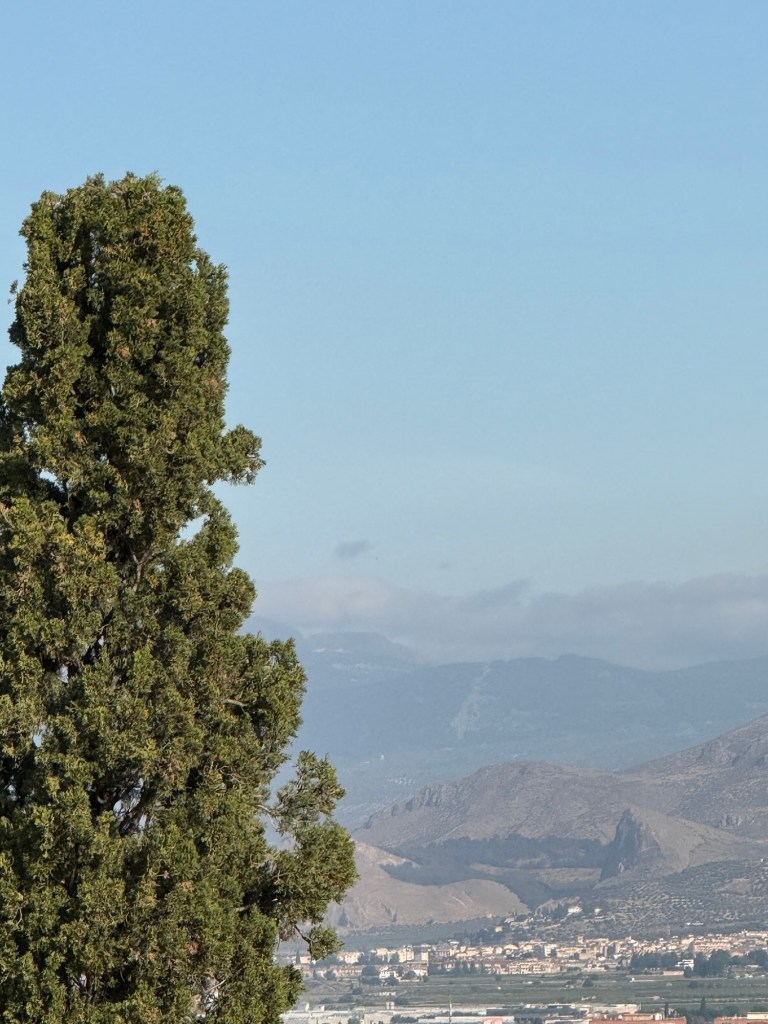
Our guide led us to another overlook. Snow-dusted Sierra Nevada peaks stood to one side—breathtaking. Then she turned and pointed south.

“On a clear day,” she said, “you can see Africa.”
Though haze blurred the view, she explained that the Rif Mountains of Morocco are sometimes visible. One continent, whispering to another.
🚻 Quick Break—Top Marks
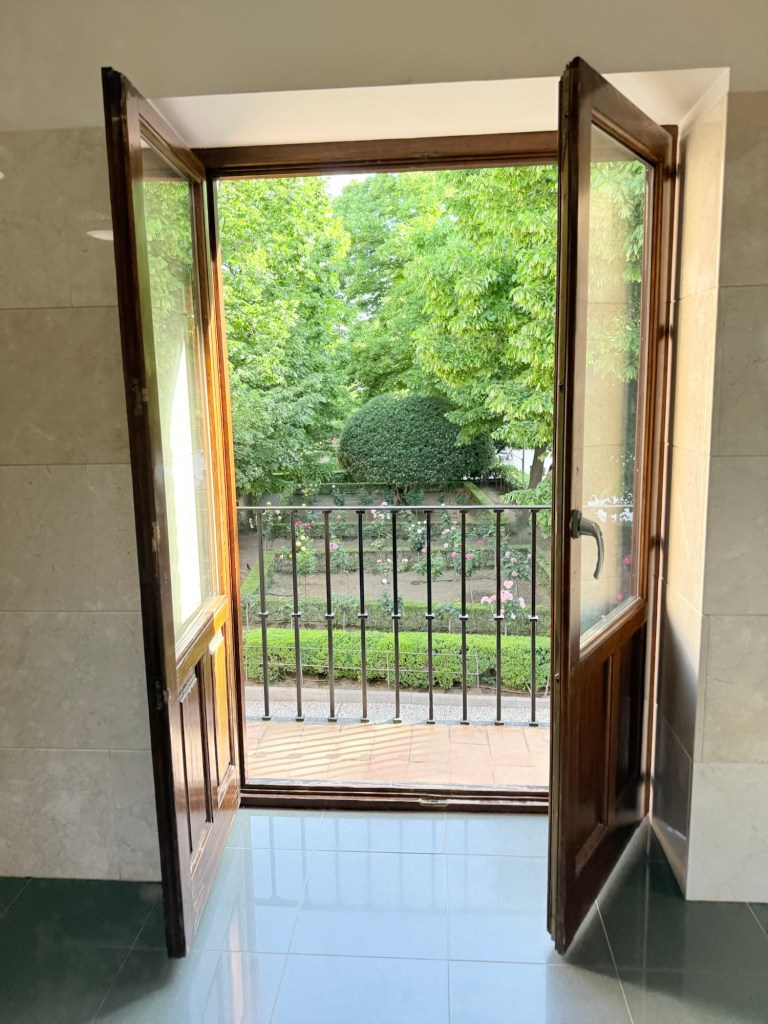
Next stop: a bathroom break. We’ve become connoisseurs of Spanish public restrooms—and this one earned a gold star. Clean, stocked, and complete with a friendly kitty drinking from the sink. Best of all? A garden view out the window.

🏛️ Inside the Nasrid Palaces
Before entering, we had to get our passports ready. Then our guide reminded us:
“Do not touch the walls.”
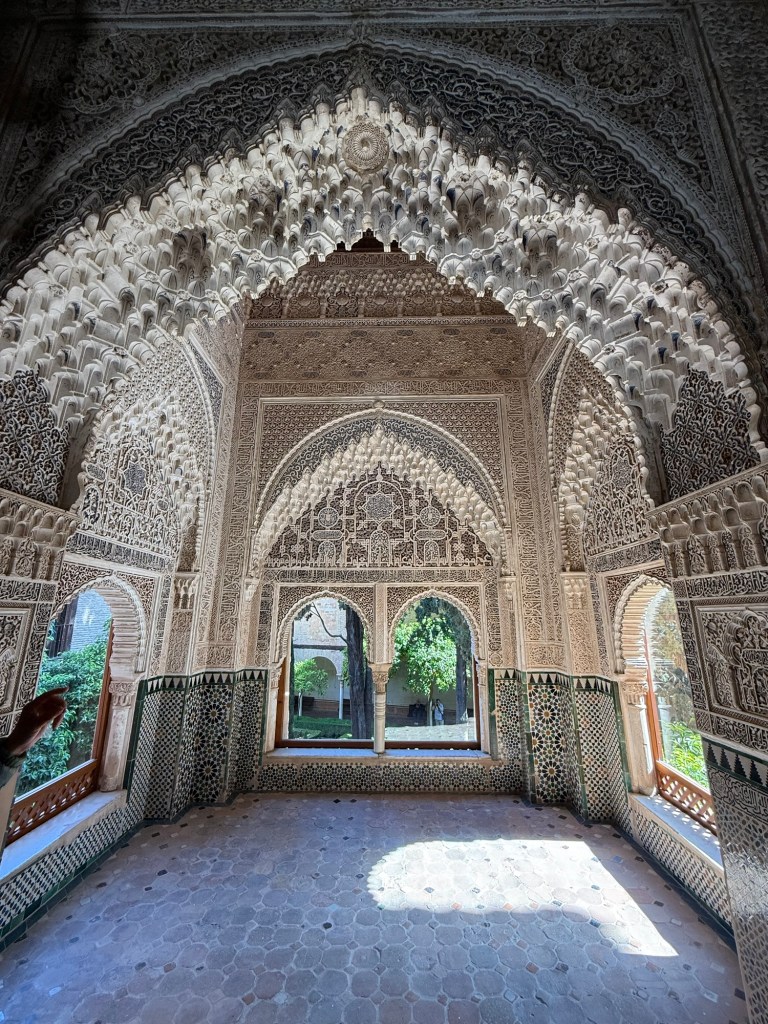
Once inside, it was clear why. The walls were covered in intricate plaster carvings, Arabic poetry, colorful mosaics, and hand-painted woodwork. Every detail was intentional.

Court of the Myrtles
Part of the Comares Palace, this courtyard housed the Sultan’s throne room and was used for formal receptions.

Hall of the Two Sisters
This and the surrounding rooms—including the famous Court of the Lions—were part of the royal harem. In Nasrid culture, the harem wasn’t just wives, but also children, attendants, and sometimes the Sultan’s mother. These quarters were off-limits to nearly all men.
Hall of the Two Sisters
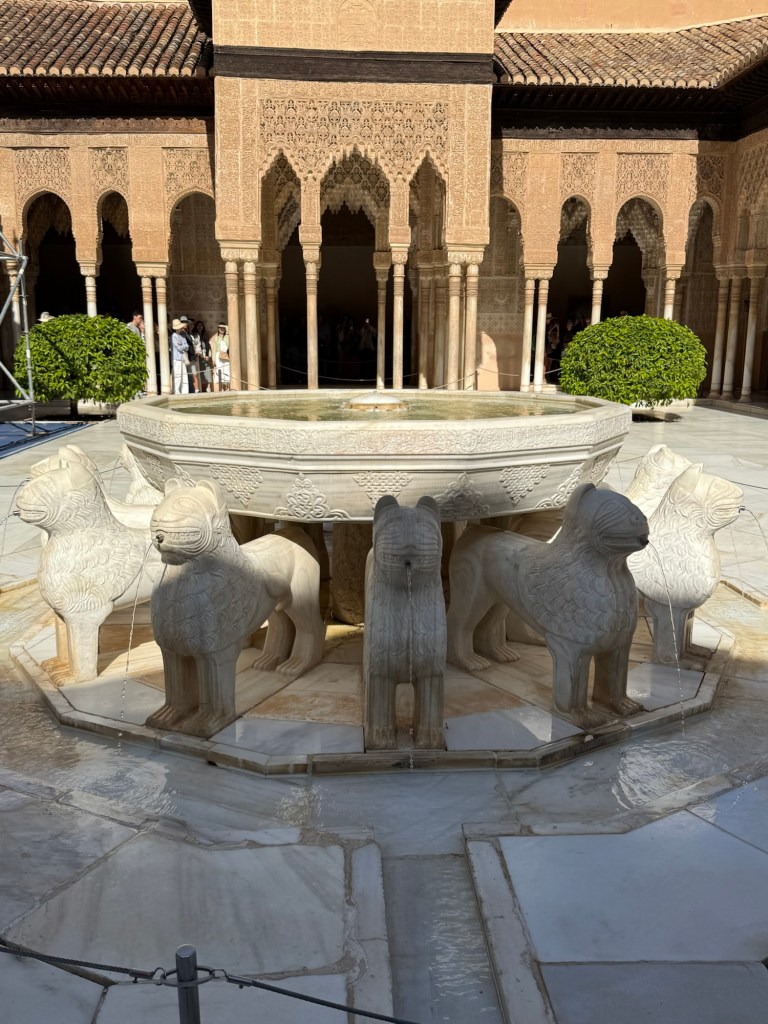
Court of the Lions
Twelve marble lions surround a central fountain, but behind the tranquil beauty lies a tale: our guide told us of a Sultan who executed his favorite wife and her alleged lover right here, consumed by jealousy.
🌳 Patio of Lindaraja & Transition to the Renaissance
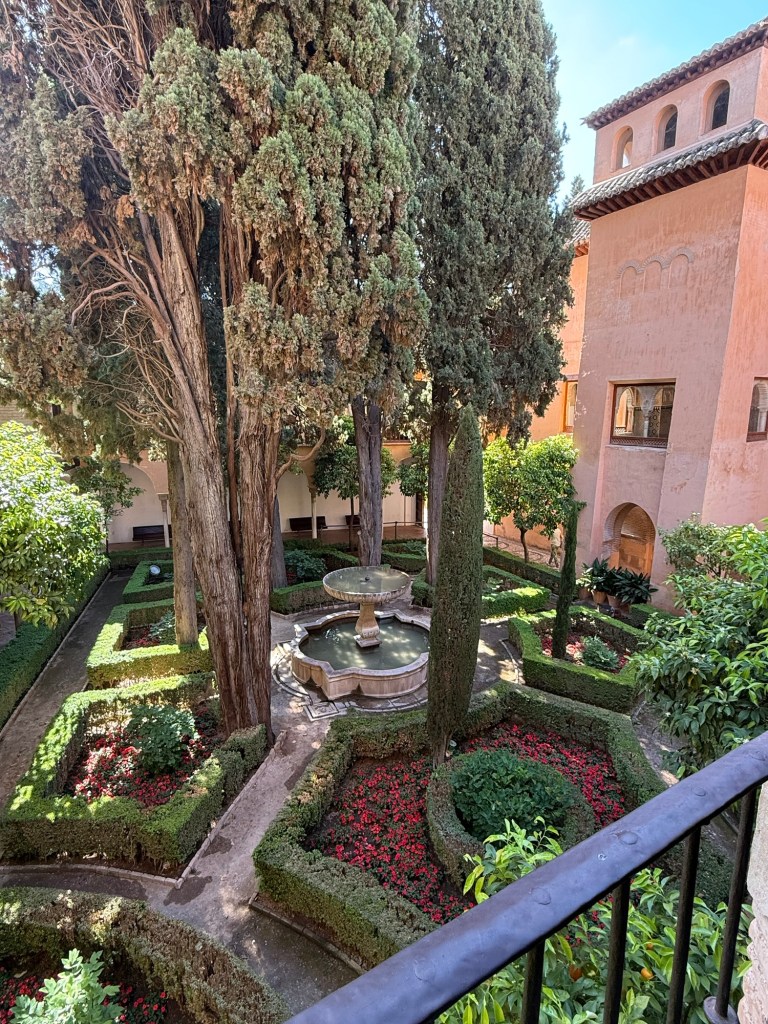
As we made our way out of the Nasrid Palaces, we passed delicate gardens and quiet overlooks.
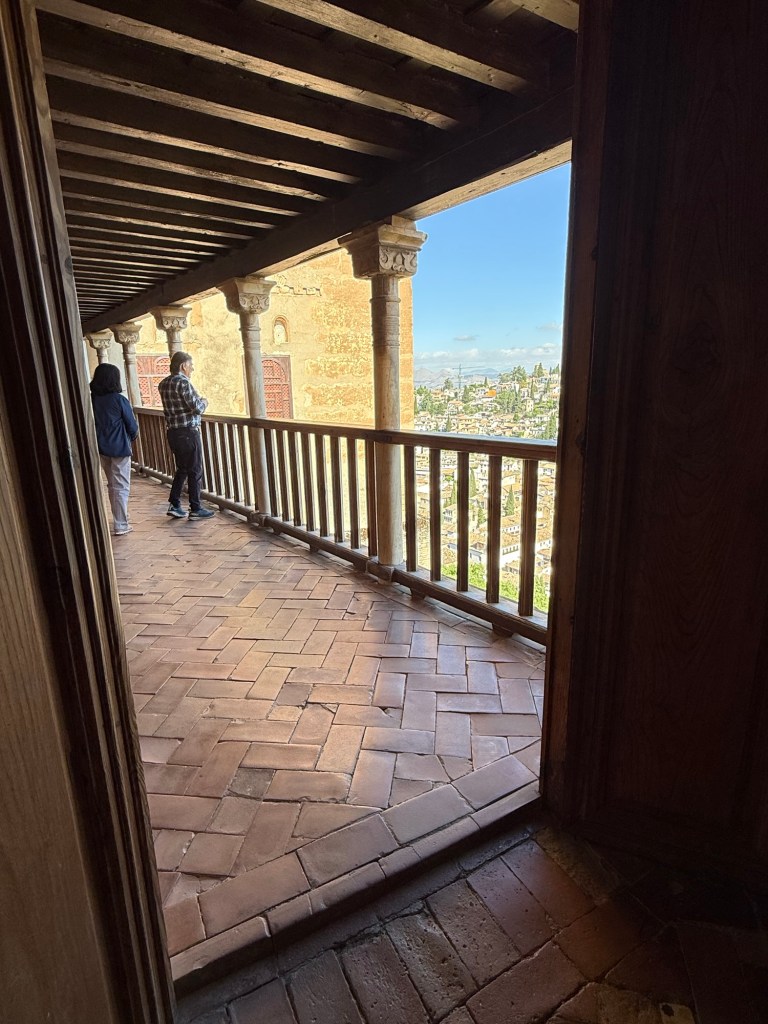
A peaceful Renaissance garden that blends Nasrid and Christian aesthetics. The layered greenery and fountains invite rest and reflection.
After the delicate arches, carved stucco, and quiet courtyards of the Nasrid Palaces, stepping into the Palace of Charles V felt like a slap of stone. Built in 1527, just a few decades after the Catholic Monarchs took Granada, it symbolized imperial power and Renaissance progress. But instead of blending in, it bulldozed the harmony of what came before. Massive, cold, and unfinished for centuries, it sits like a misplaced trophy in the middle of grace.
I took one video in the courtyard and moved on—it felt more like a museum piece than a palace.
We pulled our passports out again and continued uphill toward the Generalife Gardens. On the way, we passed a hotel tucked inside the Alhambra grounds—a luxury spot with rooms around €1,000 a night. Definitely out of our budget, but fun to dream.
🌿 Generalife Gardens
The Generalife Gardens was the sultans’ summer retreat from court life—designed as a sanctuary filled with terraced paths, flower beds, fruit trees, and fountains. The word Generalife comes from the Arabic Jannat al-‘Arīf, meaning “Garden of the Architect” or “Gardens of Paradise.”
It was stunning. At one point, I reached out to touch what looked like a fake decorative hedge—because it was so perfect—and the guide gently reminded me:
“Please don’t touch the bushes.”
Even the plants are preserved like works of art. From the top, the views of Granada were incredible, and it felt like we were standing in a living postcard.
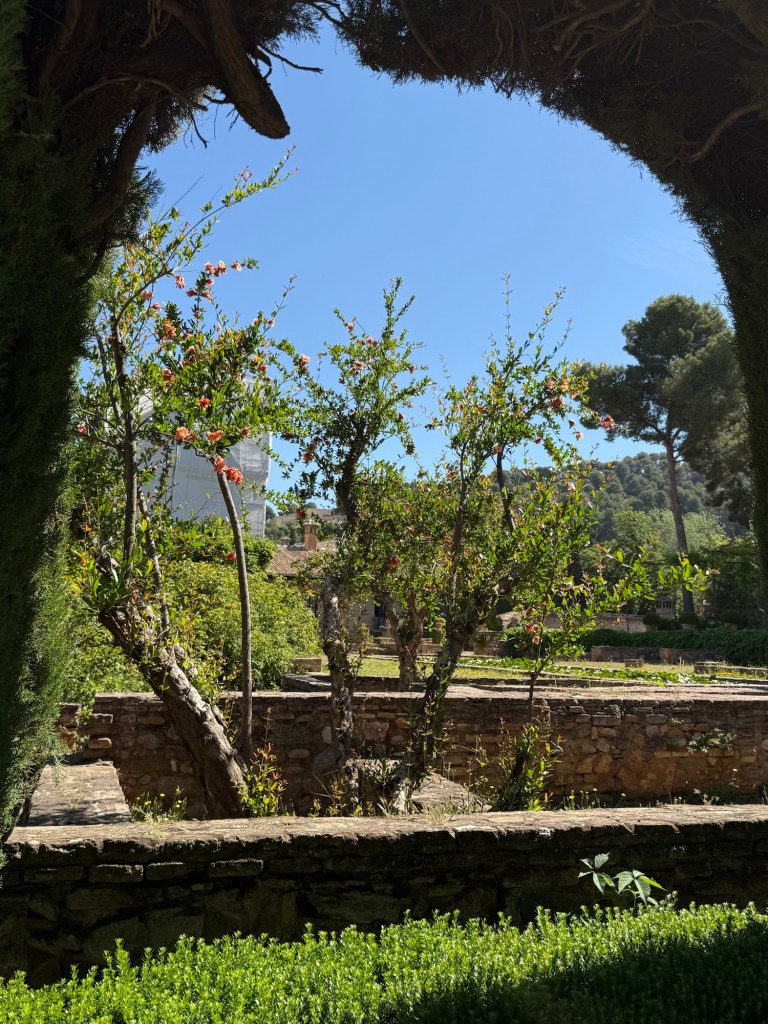
As we made our way from the palaces to the Generalife, we passed trees filled with pomegranate blossoms — a fitting symbol, since Granada means pomegranate in Spanish. The fruit appears on city emblems, fountains, and tiles throughout the region. Seeing it growing naturally here, along such a peaceful path, tied the history and the place together in the simplest, most beautiful way.
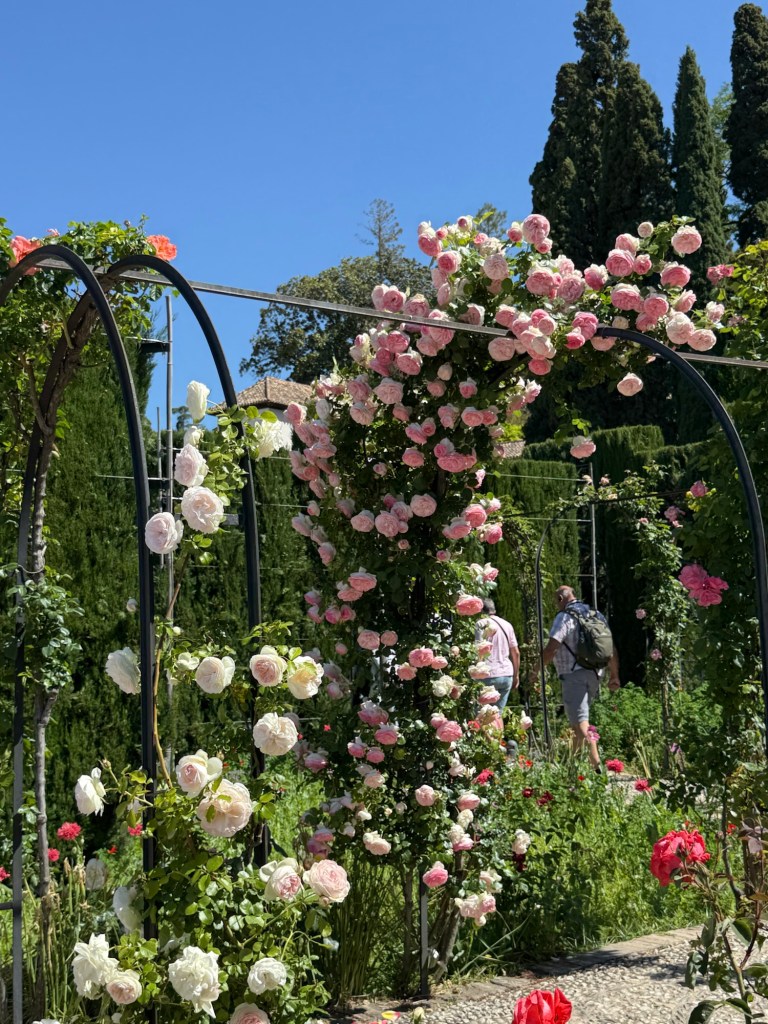
The further we walked, the softer everything became — roses climbing iron arches.
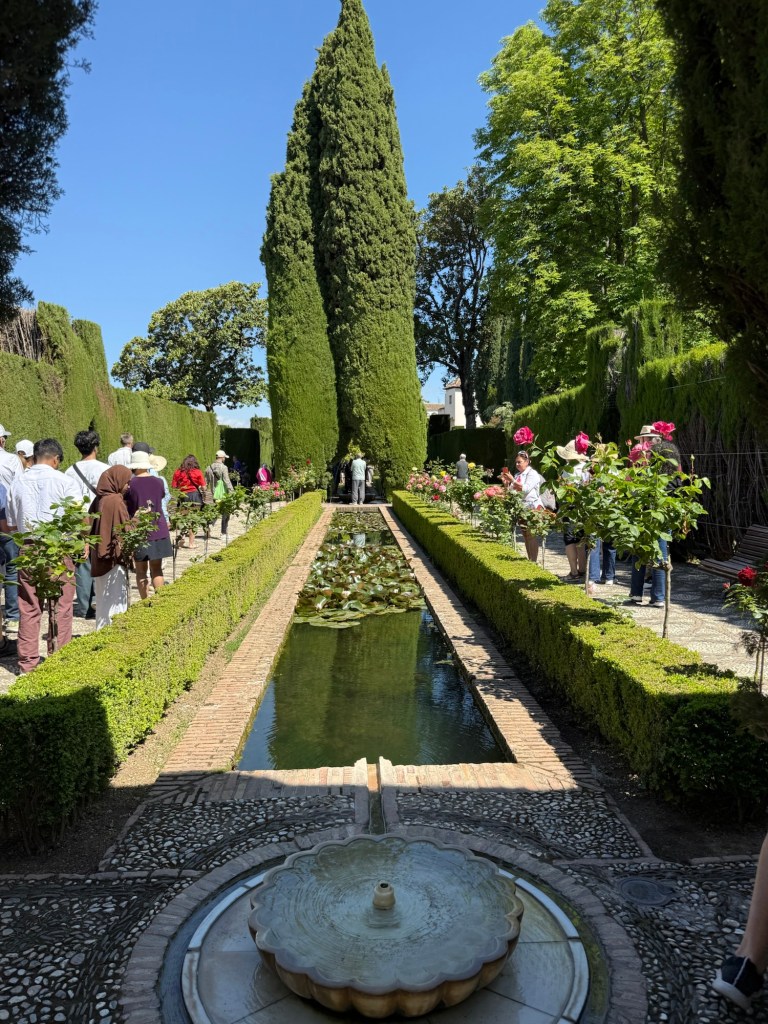
Sunlight pouring through cypress spires

Fountains trickling into long, narrow pools lined with lily pads.
And just when we thought we’d seen it all, we reached the iconic view — the long central water channel framed by white arches and overflowing flower beds.
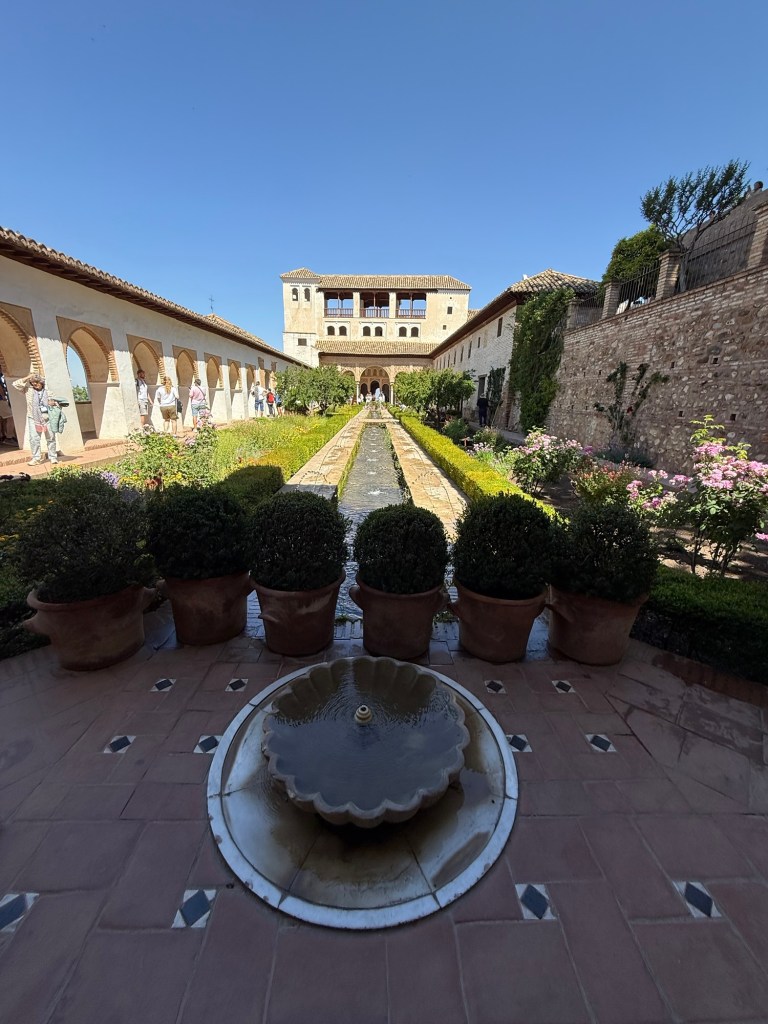
This was the postcard moment.
The Generalife reminded us that beauty isn’t always about grandeur. Sometimes it’s just water, sunlight, and roses — placed exactly where they should be.
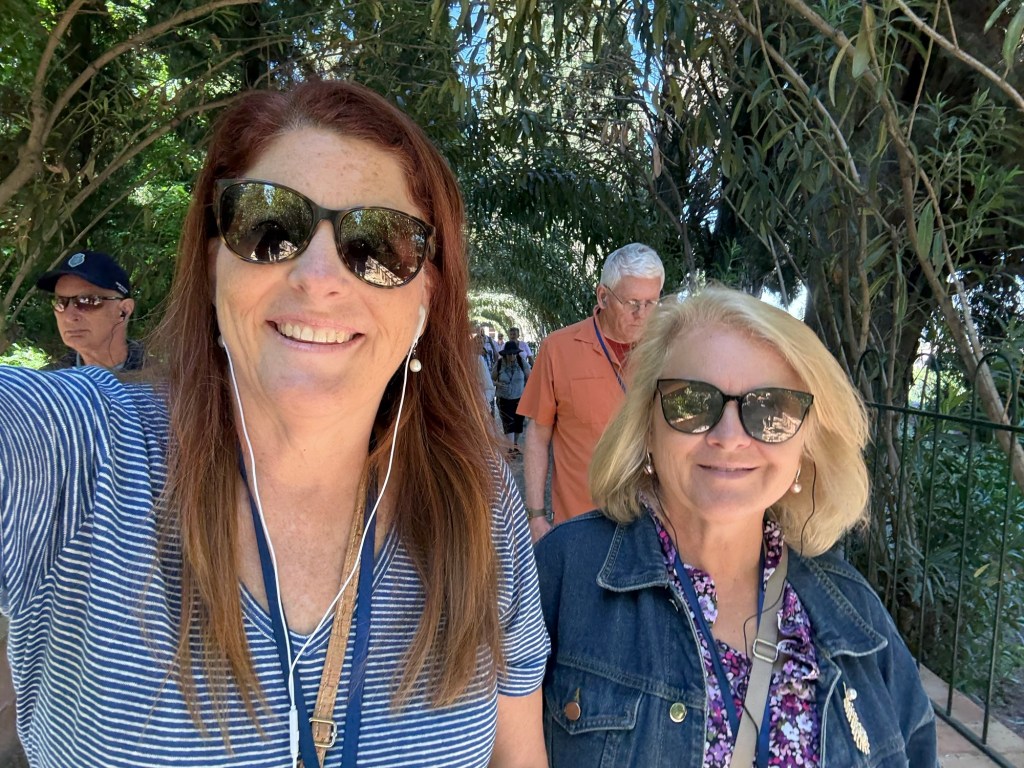
At the end of the tour, our guide gave us two options: walk down the many stone steps back into town, or take the minibus. Next up, find a good lunch spot before we head back.
 Happiness is Possible